
Fast Shipping

30-Day Money-Back Guarantee

Free Returns
 Trusted by 57,168+ quitters
Quitine Nicotine Patches Step 1 21mg 28 Pieces
28 patches (4-week kit)
Start here if you smoke more than 10 cigarettes a day. Combine with 4mg gum or lozenges for breakthrough cravings.


'%3e%3cpath%20d='M200.748%2060.8076C200.748%2056.9418%20204.949%2053.9711%20211.239%2053.9711C220.493%2053.9711%20231.329%2057.837%20237.985%2062.9033L244.986%2045.0186C236.402%2038.1821%20224.348%2035.2114%20212.295%2035.2114C192.023%2035.2114%20177.676%2047.6636%20177.859%2063.7783C178.204%2095.4988%20224.348%2085.6917%20224.531%2098.8357C224.531%20102.864%20219.641%20105.855%20211.95%20105.855C201.459%20105.855%20190.967%20102.702%20182.932%2096.74L175.586%20113.913C185.894%20121.278%20199.348%20124.778%20214.04%20124.778C233.967%20124.778%20247.948%20113.221%20247.948%2097.269C247.421%2066.4233%20200.931%2073.2598%20200.769%2060.8076H200.748Z'%20fill='black'/%3e%3cpath%20d='M284.353%2036.9612H259.718V123.008H284.353V36.9612Z'%20fill='black'/%3e%3cpath%20d='M453.002%2036.9612V49.2303C447.056%2040.2981%20437.803%2035.2114%20425.729%2035.2114C403.529%2035.2114%20385.875%2055.1919%20385.875%2079.8929C385.875%20104.594%20403.529%20124.757%20425.729%20124.757C437.783%20124.757%20447.056%20119.671%20453.002%20110.739V123.008H477.637V36.9612H453.002ZM431.512%20101.46C419.621%20101.46%20410.023%2092.0195%20410.023%2079.9132C410.023%2067.8069%20419.641%2058.366%20431.512%2058.366C443.383%2058.366%20453.002%2067.8069%20453.002%2079.9132C453.002%2092.0195%20443.566%20101.46%20431.512%20101.46Z'%20fill='black'/%3e%3cpath%20d='M386.342%2036.9612H356.086L332.08%2067.6441H326.378V36.9612H301.743V123.008H326.378V89.3541H331.979L357.486%20123.008H389.122L352.555%2078.489L386.342%2036.9612Z'%20fill='black'/%3e%3c/g%3e%3crect%20x='0.363281'%20y='16.6689'%20width='126'%20height='126'%20rx='11.6497'%20fill='%2384EF84'/%3e%3cpath%20fill-rule='evenodd'%20clip-rule='evenodd'%20d='M48.1406%2087.4129L122.525%200.428223L140.698%2016.5266L54.9343%20116.818C44.2467%20129.316%2024.0488%20121.622%2024.0488%20105.053V46.2353H48.1406V87.4129Z'%20fill='black'/%3e%3cdefs%3e%3cclipPath%20id='clip0_1895_3210'%3e%3crect%20width='302.051'%20height='89.546'%20fill='white'%20transform='translate(175.586%2035.2114)'/%3e%3c/clipPath%3e%3c/defs%3e%3c/svg%3e)
Fast Shipping
30-Day Money-Back Guarantee
Free Returns
Active Ingredients: Nicotine, 21mg delivered over 24 hoursInactive Ingredients: acrylate adhesive, polyester, silicone adhesive
Quitine nicotine patches are an over-the-counter stop smoking aid that delivers a steady, controlled amount of nicotine over 24 hours through your skin. Apply one patch each morning to clean, dry skin and let it work in the background all day. No timing, no counting, just consistent baseline support so you can focus on breaking the habit, not managing the cravings.
- Step 1: Choose clean, dry, hairless skin on your upper arm, chest, or back. Avoid lotions or oils before applying.
- Step 2: Peel the liner and press the patch firmly for 10–20 seconds. Smooth the edges down for best hold.
- Step 3: Wear for 24 hours. Designed for all-day wear, including during everyday activities.
- Step 4: Remove after 24 hours and apply a new patch to a different skin site. Rotate daily for comfort.
Note: Stop use if skin irritation occurs. See package directions.

Try Quitine Risk-Free
If it's not right for you, we offer a 30-day money-back guarantee. No stress. No risk. Just support.
Learn More About Our Guarantee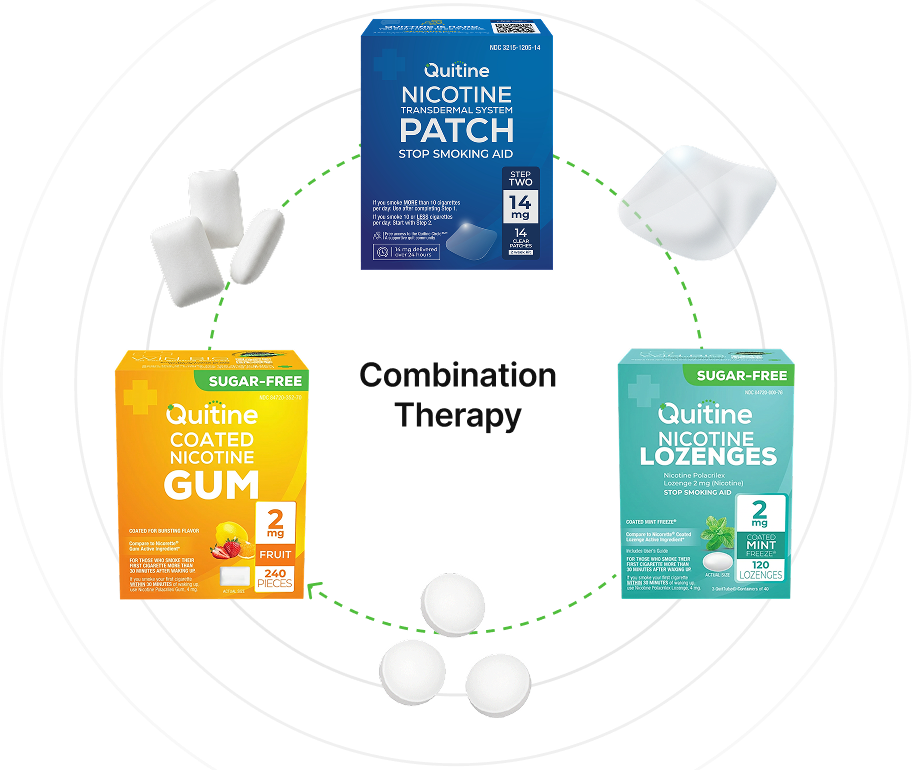
Add breakthrough craving support
The patch handles your all-day baseline. When a craving hits hard, after a meal, under stress, on a break, 4mg gum or lozenges give you fast top-up support.
Features
| Feature | Lozenges | Gum | Patches |
|---|---|---|---|
| When to use | Discreet cravings | Active cravings | All-day baseline |
| Experience | Dissolve | Chew and park | Wear and forget |
| Oral habit support | Partial | Yes | No |
| Best for | Discreet convenience | Active control, oral habit | Steady all-day coverage |
| Combined with patches | Yes - recommended | Yes - recommended | Use as the base layer |
Which Patch is right for you?

Step 1
Experience: The highest strength. Delivers a steady dose of nicotine over 24 hours through a clear, thin patch. Apply once daily to clean dry skin.
Best For: Those who smoke more than 10 cigarettes a day. If you vape and are not sure where you sit, the quiz will place you.

Step 2
Experience: A lower dose for steady all-day support. Use after completing Step 1, or start here if you are a lighter smoker or vaper.
Best For: Those who smoke 10 or fewer cigarettes a day, starting here and skipping Step 1. Also the next step after completing Step 1.

Step 3
Experience: The lowest dose. Your final taper before stopping NRT entirely. Still provides support while your body adjusts to lower nicotine levels.
Best For: Those who have completed Step 2 and are in the final phase of tapering. Most people manage this step with 2mg gum or lozenges alongside it.
Stick it. Forget it. Nicotine absorbs through your skin over 24 hours.
90-Day Plan

Days 1–42:
Phase 1
Step 1 (21mg). Apply one patch daily. Use 4mg gum or lozenges for breakthrough cravings.

Days 43-56:
Phase 2
Step 2 (14mg). Step down after completing Step 1. Use 2mg gum or lozenges for any remaining cravings.

Days 57-90:
Phase 3
Step 3 (7mg). Final patch taper. Most people manage without oral support, use 2mg lozenges or gum on harder days if needed.
Benefits
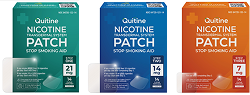
Patches - All Steps

Delivers nicotine steadily over 24 hours, wear and forget

Clear, thin, and discreet, sticks well and stays on throughout the day

Step 1 (21mg), Step 2 (14mg), Step 3 (7mg), structured step-down program

Can be combined with gum or lozenges for breakthrough craving support

Pharmacist-founded. 30-day money-back guarantee.
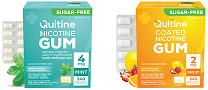
Gum Mint & Fruit

Quick-burst mint flavor with a consistent, satisfying chew

Chew-and-park method for controlled, steady nicotine release

Helps replace the oral habit of smoking or vaping

More pieces per pack than most brands, at a lower cost per piece
Pharmacist-founded. 30-day money-back guarantee.
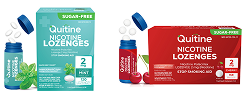
Lozenges Mint & Cherry
Refreshing mint flavor with no harsh aftertaste, not gritty or chalky

Dissolves without chewing, discreet enough to use anywhere

Nicotine absorbs through your gum tissue for craving relief

Child-proof, tamper-proof QuitTubes, double sealed for freshness
Pharmacist-founded. 30-day money-back guarantee.
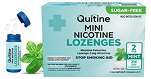
Lozenges Mint Mini

Compact mini size, pocket-friendly and faster-dissolving for quick support
Refreshing mint flavor with no harsh aftertaste
Nicotine absorbs through your gum tissue for effective craving relief
Child-proof, tamper-proof QuitTubes, double sealed for freshness
Pharmacist-founded. 30-day money-back guarantee.
Quitine x Competitors
 | Others | |
|---|---|---|
| Appearance | Transparent, blends with skin | Beige or tan, visible on skin |
| Wearability | Comes off cleanly, no marks left | Can leave sticky residue or marks |
| Guarantee | 30-day money-back (risk-free) | Limited or none |
| Who Made It | Pharmacist with 40+ years of experience | A big-brand label, no one to ask |
| Customer Support | Personalized, consistent support | Generic or automated responses |
| Value | More patches per dollar | Higher cost per patch |
| Ingredients | FDA-approved active ingredient, fully disclosed | Limited or unclear transparency |
| Pack Size | 14 or 28 patches per box | 14 or 28 patches per box |

Why Quitine?
FDA
Same FDA-approved active ingredient as leading brands, at a lower price
Founder
Pharmacist-founded by Mark La Hood 40+ years of experience
Support
Personalized, consistent customer support, not a bot
Guarantee
30-day money-back guarantee on every product
Real Quitters. Real Wins.
Bought for her son
I got all three steps for my son... I like that it comes with a free support group called the Quitine Circle. I hope he will join.

Susan
Tennessee
Smoked 46 years, quit 7 months ago
Smoked 46 years then found these and quit 7 months ago. Feel great and still pop one when I feel weak. Loving the help!

Inga
Kentucky
Clean product
If you are looking for a clean, straightforward way to manage nicotine, whether it's to quit smoking or sharpen up mentally, this is a solid choice. It's thoughtfully made, well-packaged, and more affordable than a lot of what's out there. Developed by a pharmacist with decades of experience, which adds some peace of mind.

Thomas
Arkansas
Lozenges
The lozenges have to be dissolved slowly in the mouth… He just keeps it under his tongue until it's gone… I like that the company distributes the lozenges in a container with a child safety cap. Emergency poison control numbers are on each bottle… Supportive literature with helpful tips for quitting the nicotine habit are also included. The Quitine company is very committed to a successful outcome for every customer.

Kathy
Alabama
Lifesaver
This is a LIFESAVER! I decided to give this a try because the price per piece was a huge savings… I like the name. I am trying to quit, so Quitine seems to be aptly named. I am hoping to use this till the pieces are gone and then move to their 2mg version. I'm gonna grab some of their lozenges too.

Lance
Mississippi
The best customer service
This company has really awesome customer service and for the price I really wanted to like it… The company is really cool and run by pretty nice people. Id rather give my money to folks like them than some big brand.

Chelsey
Indiana
I've used other lozenges from this brand so when I saw these little mints I didn't pay as much attention… These are perfect for folks who are just starting the journey of quitting cigarettes. Quitting smoking is a journey and I believe lozenges help on the journey.

Patricia
Missouri
Blessed
I also appreciate that this is made in the USA and created by a pharmacist with real experience. It adds a layer of trust to the product. It's affordable, straightforward, and seems to be doing the job without any unnecessary frills.

Denise
North Carolina
The Quitine lozenges are crafted by pharmacist Mark La Hood, so that gives me much more confidence in the safety of the product. Very high quality nicotine replacement therapy at an affordable price!

Kelly
Louisiana
Transparency
Quitine has a webpage at quitine.com and the 'Why Quitine' page includes an informative video made by the pharmacist/co-founder. Accountability: Unlike supplements, nicotine gum is required to be FDA-approved, which brings a level of accountability. It's also reassuring that there's a pharmacist who stands behind the brand.

Gary
Oklahoma
Former vaper, now free
Quitine was a game-changer. Their products were my lifeline through the hardest days. I've reclaimed my health and life is so much more fulfilling now.”

Luke
Pennsylvania
Quit after 23 years
Quitine gave me access to products I could actually afford. The quality is real, the shipping is fast, and I finally feel supported. Keep doing what you're doing!

Debbie
South Carolina
Smoke-free for 8 months
Quitting smoking was one of the most rewarding choices I've ever made. It's been challenging at times, but so worth it. I feel healthier, more energetic. I've reclaimed my life.

Brenda
West Virginia

Three people. One mission.
We built Quitine because quitting should feel possible, and no one should have to do it alone.

Mark La Hood
Co-Founder & Pharmacist
Pharmacist with 40+ years of experience. Built Quitine because he’d watched thousands of patients struggle through the same cycle of trying, relapsing, and trying again.

Ollie Roulston
Co-Founder & CEO
Brand vision, customer support, and operations. Focused on making every part of the Quitine experience easy, accessible, and worth trusting.

Janelle Page
Co-Founder & CMO
Brand vision, marketing, and community support. Building the Quitine Circle into a place where quitting feels supported, not lonely.

Help Someone Quit. Get Rewarded.
Share Quitine with a friend. You both save on your next step.

Your friend gets $10 off their first order

You get $10 off your next order
How it Works
Step 1
Share your personal referral link
Step 2
Your friend places their first order and saves $10
Step 3
You get $10 off your next purchase automatically
Every referral helps someone take their first step with a structured quit plan.
Takes less than 30 seconds to share.
Frequently Asked Questions
Patch step goes on how many cigarettes you smoke a day. More than 10 a day starts on Step 1 (21 mg). 10 or fewer starts on Step 2 (14 mg), skipping Step 1 entirely. Step 3 (7 mg) is the final taper you move onto after Step 2. Vaping does not map neatly onto cigarette counts, so if you vape, take the quiz or message us and Mark, our pharmacist, will help you place it.
Yes, the patches are made for 24-hour wear. Some people get vivid dreams when they wear it overnight, so if that's you, take it off before bed and put a fresh one on in the morning.
The step-down program runs about 10 weeks: 6 weeks on Step 1 (21 mg), then 2 weeks on Step 2 (14 mg), then 2 weeks on Step 3 (7 mg). If you're also using gum or lozenges for breakthrough cravings, you can keep tapering those for another 2 to 3 weeks after the patches finish. The full 90-day framework is there to give you time to build new habits while you reduce nicotine gradually. Always follow the directions on the pack.
Combination therapy means wearing a patch for steady all-day support and using gum or lozenges when cravings break through. We recommend it for most people because the patch handles your baseline nicotine level and the gum or lozenge handles the spikes. Take the Quit Quiz and it'll tell you whether combo therapy makes sense for you.
Yes. Not everyone wants to stop all at once. The 90-Day Quit Program is built around gradually reducing nicotine, so it works just as well if your goal is to cut back significantly first and decide what's next later. A lot of people start out wanting to cut back and end up quitting fully.
The Quitine Circle is our free support community, open to everyone quitting smoking or vaping. No purchase is required, and you do not need to use Quitine products to participate. Inside you get short video modules, a downloadable workbook, weekly live Q&A sessions, and a private community moderated by the Quitine team. The structure is the part most people say keeps them on track when willpower runs out.
Yes, returns are free. Message us on the chat box at the bottom left of the site or email info@quitine.com and we'll arrange it.
Yes. Subscribers get 10% off, and you can pause, skip, cancel, or edit your subscription at any time before your next order is processed. No lock-in and no penalty for changing your plan.
Stick it on clean, dry, hairless skin on your upper arm, chest, or back. Press firmly for 10 to 20 seconds, especially around the edges so it sticks properly. Rotate where you put it each day to avoid skin irritation.
Just put on a fresh one. Make sure the skin is completely clean and dry first, avoid areas with body hair or where the skin folds, and smooth the edges down firmly when you apply it.
Yes, and we'd encourage it. This is what's called combination therapy. The patch handles your baseline nicotine level, and gum or lozenges give you something to reach for when a craving hits harder than the patch alone can deal with. Pair 4 mg gum or lozenges with Step 1, and 2 mg with Step 2.
Quitine products are nicotine replacement therapy, so there are a few people who should talk to a doctor or pharmacist before starting. That includes anyone who's pregnant or breastfeeding, anyone under 18, anyone with a heart condition or recent heart attack, and anyone taking medication that might interact with nicotine. If you're not sure, message us on the chat box at the bottom left of the site, email info@quitine.com, or speak to your doctor or pharmacist.
The fastest way is to take the 2-minute Quit Quiz. It asks about your habits and recommends the right products, the right strength, and a step-down plan that fits you. From there you join the Quitine Circle (free for everyone, no purchase needed) and use the workbook to track your progress.
The Quitine Guarantee is our 30-day money-back guarantee on every product, no fuss. Separately, the Quitine Circle and 90-Day Quit Program are free and open to everyone, whether or not you buy. Quitting is hard enough without the products being a financial risk too. If you want to claim the money-back guarantee, message us on the chat box at the bottom left of the site or email info@quitine.com.
Orders ship within 24 hours. Packaging is discreet, with no Quitine branding on the outside of the box.
Most people pick every 30 days, which works for a typical pace. If you go through multiple pieces a day, every 2 weeks is closer to right. Later in the taper, when you're using less, every 60 or 90 days is more common. You can change the frequency at any time from your account.