
Nicotine patches for beginners: what should you expect?

Nicotine patches for beginners work in a simple way. You stick one on clean skin each morning. Nicotine moves through the skin all day and takes the sharp edge off nicotine withdrawal. You will still feel urges. They often arrive slower than they did after a cigarette or a vape.
This guide walks through first-day application, the right starting strength, early side effects, and how the weeks usually feel when you use nicotine patches as part of a step-down plan.
Beginners can get better results by understanding the most common mistakes using nicotine patches, knowing who should not use nicotine patches, and recognizing when to stop using nicotine patches as part of a structured quit-smoking plan.
Get Your Personalized Quit Plan.
What a nicotine patch actually does
A nicotine patch is a thin sticker that holds nicotine in a layer next to your skin. The skin soaks that nicotine in slowly. Blood levels rise over a few hours, then stay fairly even while the patch stays on. That even flow is the point. A cigarette or vape spikes nicotine fast, then drops it. The crash after that drop is what many people call a nicotine craving.
The patch does not copy the hit of smoke. It replaces some of the nicotine your body is used to, without the tar, carbon monoxide, or extra chemicals in tobacco smoke. The U.S. Centers for Disease Control and Prevention describes the patch as a once-a-day option that can sit under clothing and stay on in the shower.
Expect this on day one:
- Background restlessness often eases before the "I need a cigarette now" feeling fully goes away.
- The first hours can still feel edgy because the patch has not reached a steady level yet.
- Hand-to-mouth habits do not vanish.
- The patch treats nicotine hunger, not the motion of smoking.
That gap is why many beginners pair a patch with a faster nicotine product later in this guide. A short read on how nicotine patches work explains the slow rise in blood nicotine if you want the mechanism without the medical jargon.
How to apply a nicotine patch the first time
Read the leaflet in your box. The steps below match common FDA-labeled directions and the CDC how-to guide.
Pick a time you can repeat every day, usually after you wake up. Choose clean, dry, hair-light skin between the neck and the waist. Upper arm, shoulder, upper chest, and upper back work well. Skip oily lotion, broken skin, scars, rashes, and skin folds.
Open the pouch. Peel the backing. Press the sticky side to the skin right away. Hold the patch with your palm for about 10 seconds, especially around the edges. Wash your hands with water so leftover nicotine does not reach your eyes or mouth. Wear one patch at a time. Never cut a patch to change the dose.
If a patch loosens or falls off, put on a new one. Fold a used patch sticky sides together, slide it back into the pouch, and throw it away where children and pets cannot reach it. MedlinePlus notes that leftover nicotine on a used patch can still harm a child or pet.
Rotate the nicotine patch placement each day. Do not park a new patch on the same patch of skin more than once in a week. That one habit prevents a lot of redness.
You can shower, bathe, and sweat with most 24-hour patches on. Pat the area dry. Do not scrub the patch.
Which strength a beginner should start with
Patches usually come in 21 mg, 14 mg, and 7 mg. The starting step tracks how much nicotine you used, not how motivated you feel.
The 21 mg nicotine patch suits people who smoke or vape heavily and want all-day cover from the first morning. The 14 mg nicotine patch fits lighter use, or the middle weeks after the higher step. The 7 mg nicotine patch finishes the taper.
If you wake up desperate for nicotine, wear the patch overnight. If sleep turns strange, peel it off at bedtime and put a fresh one on in the morning. Some people wear a patch for 16 hours and others wear it 24 hours. Both patterns are used.
A two-minute quit smoking quiz can match the first step to how soon you reach for nicotine after waking. Guessing low often leaves you under-dosed. Guessing high can leave you jittery. The label and a pharmacist or clinician can settle edge cases, including heart disease, pregnancy, or medicines you already take.
What the first days and first weeks feel like
Hour one to hour three: many people feel little change. Skin may tingle or itch under the patch. That often fades.
Later on day one: nicotine in the blood is still climbing. Morning coffee, the drive to work, or the first work break can still punch hard. Have a plan for those minutes that does not involve lighting up.
Days two to four: this stretch is often the roughest. The body is used to spikes. A steady patch is quieter than a cigarette, so the brain still looks for the old rush. Irritability, a foggy head, extra hunger, and a short temper show up for some people. That is nicotine withdrawal meeting a new delivery method, not a sign the patch "is not working."
After the first week or two: many people notice fewer all-day nicotine cravings. Taste and smell can start to come back. Coughing may change before it settles. Sleep can still be odd if you wear the patch at night.
Later weeks: the job of the patch is to hold the floor while you change routines. The cigarette after meals, the vape in the car, and the smoke break with coworkers are habits. The patch will not replace daily smoking habits on its own. Swap the routine. Walk, chew sugar-free gum, drink water, or step outside without a device in your hand.
Stay on the full step-down instead of ripping the patch off the first good day. Stopping early is a common reason people slide back.
Side effects beginners notice most
No one gets every nicotine patch side effect. Some people get none.
Skin under the patch. Redness, itch, or a mild burn is the most common complaint. Rotate sites. Avoid lotion under the patch. If skin irritation with nicotine patches lasts more than a few days, the skin swells, or a rash spreads, take the patch off and talk with a clinician.
Sleep. Vivid dreams and broken sleep happen more when the patch stays on overnight. Remove it at bedtime if that starts.
Headache, nausea, or a racing heart. These can mean the dose is high for you, or that you are still smoking or vaping on top of the patch. Do not stack extra nicotine from cigarettes while the patch is on, unless a clinician has set a short, supervised plan. Too much nicotine can bring dizziness, a fast pulse, and an upset stomach.
Odd dreams, restlessness, or a sour stomach. These often ease after the body adjusts. A lower step can help if they stay loud. Stop and get medical help if you have chest pain, a severe rash, trouble breathing, or signs of an allergic reaction.
MRI scans and some patches do not mix well. Tell the imaging team you wear a nicotine patch. Some opaque patches can heat on the skin during a scan.
Why many beginners add gum or a lozenge
The patch is slow on purpose. A sudden craving after lunch does not wait three hours. That is the case for combination NRT: one long-acting patch plus a short-acting piece you use only when an urge spikes.
Nicotine gum uses a chew-and-park method. You chew until you taste it, park it between cheek and gum, then chew again. Nicotine lozenges dissolve in the mouth. Neither is candy. Swallowing the nicotine can upset the stomach.
A simple pairing looks like this:
- Patch on in the morning for the baseline.
- A 4 mg nicotine gum if you used nicotine within 30 minutes of waking and a craving still breaks through.
- A 2 mg nicotine gum if you used nicotine later in the morning and the urge is milder.
- Keep the daily piece count inside the label.
Do not wear two patches to chase a craving. Use the fast oral nicotine product instead. The page on how to use nicotine replacement walks through patch, gum, and lozenge technique in one place so you are not guessing on day one.
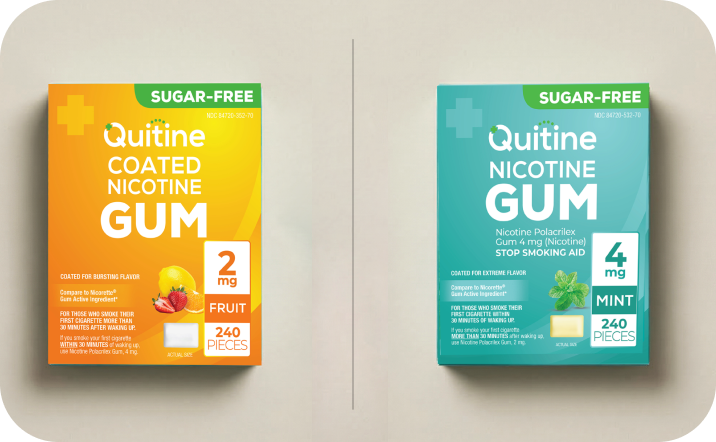
How Nicotine Gum Works
Nicotine gum delivers nicotine through the lining of your mouth as you chew. Unlike regular chewing gum, you need to use a specific "chew and park" technique to get the full effect.
Best for habit-triggered cravings
If you smoke or vape in response to specific triggers, after meals, during breaks, or when stressed, nicotine gum gives you something to do with your hands and mouth, which can help replace the physical habit.
Which Should You Choose?
The best choice depends on your personal preferences and smoking habits. If you miss the hand-to-mouth motion of smoking, gum might feel more natural. If you prefer something completely discreet, lozenges are a great option.Many people find that combining products, like using patches for all-day coverage and gum or lozenges for breakthrough cravings, gives them the best results.
Product Comparison
| Best For | Strength | |
|---|---|---|
| Nicotine Gum | Habit-triggered cravings | 2mg / 4mg |
| Nicotine Lozenges | Discreet craving relief | 2mg / 4mg |
| Nicotine Patches | All-day support | 21mg / 14mg / 7mg |
How long you wear the patch and when you step down
Most boxed programs last several weeks, then drop the dose. A typical heavy-use path is weeks on 21 mg, then a shorter stretch on 14 mg, then a final stretch on 7 mg. Lighter use often starts on 14 mg and ends on 7 mg.
Some people need more time on a step. Going back to smoking is harder on the body than staying on a labeled NRT plan a little longer. Ask a clinician if you feel unstable when a drop is due.
Wear the patch every day. Skipping "good days" lets blood nicotine bounce, which can restart the craving cycle.
Mistakes that trip up first-time users
- Starting on a step that is too weak because the 21 mg box "looks intense."
- Smoking or vaping "just one" while the patch is on, then feeling sick and blaming the patch.
- Parking the patch on the same arm for a week.
- Cutting a patch in half.
- Taking the patch off after three good days.
- Using the patch but changing nothing about coffee, alcohol, or smoke-break friends.
- Ignoring skin care, then quitting the patch because of a rash that site rotation would have prevented.
- Leaving used patches on a nightstand.
Write your quit day on a calendar. Put the new patch on that morning, even if the last cigarette was messy. Consistency beats a perfect mood.
Discover Quitine and our best NRT products
Why Quitine?
Meet Mark and Oliver, the founders of Quitine. Mark has more than 40 years of experience as a pharmacist. His father’s long struggle with smoking shaped the work he does today. He has spent his career helping people leave cigarettes and vapes behind. Oliver brings deep experience in ecommerce, branding, product development, marketing, and logistics. Together they built Quitine to offer clear, practical nicotine replacement therapies that fit real daily life.
Our NRT products
Our pharmacist-formulated NRT products are made to support you while you change the habits that go with smoking or vaping.
Combination therapy for higher quit success
Research shows that combining a long-acting nicotine patch with a faster-acting form of NRT such as nicotine gum or nicotine lozenges can raise the chance of quitting smoking by 17 to 37 percent compared with using one product alone. At Quitine our nicotine patches deliver a steady amount of nicotine through the skin all day. Our nicotine gum and lozenges give you something to use when a craving hits. This dual approach, called NRT combination therapy, gives you more flexibility so you can stay comfortable while you change the habit.
Accessible pricing
We believe quitting should be within reach for everyone. We keep our therapies priced so more people can start without cutting corners on quality.
Personalized support
Quitting is personal, and so is the way we work with you. From the customer service team to the way each product is formulated, we stay with you through the process.
The Quitine Circle
The Quitine Circle is our free 90-day guided quit program and private support community. It is open to anyone quitting smoking or vaping and requires no purchase. It follows the same structured, pharmacist-backed approach that shapes our NRT products. You get short training modules, a practical quit workbook, weekly live Q and A sessions, and a moderated space with other people who are quitting, so you do not have to rely on willpower alone.
Discover which NRT is right for you
Not sure which product suits you best? Take our personalized quiz to find the NRT product that fits your needs. Take the Quiz
Real quitters. Real success.
See what our customers are saying about Quitine nicotine replacement therapy. Read Case Studies
The Quitine guarantee
Your satisfaction is covered. Learn more about our 30-day money-back promise. Learn More About Our Guarantee
Discover our best nicotine patches - Quitine
1) Quitine Nicotine Patches Step 1 21mg 28 Pieces
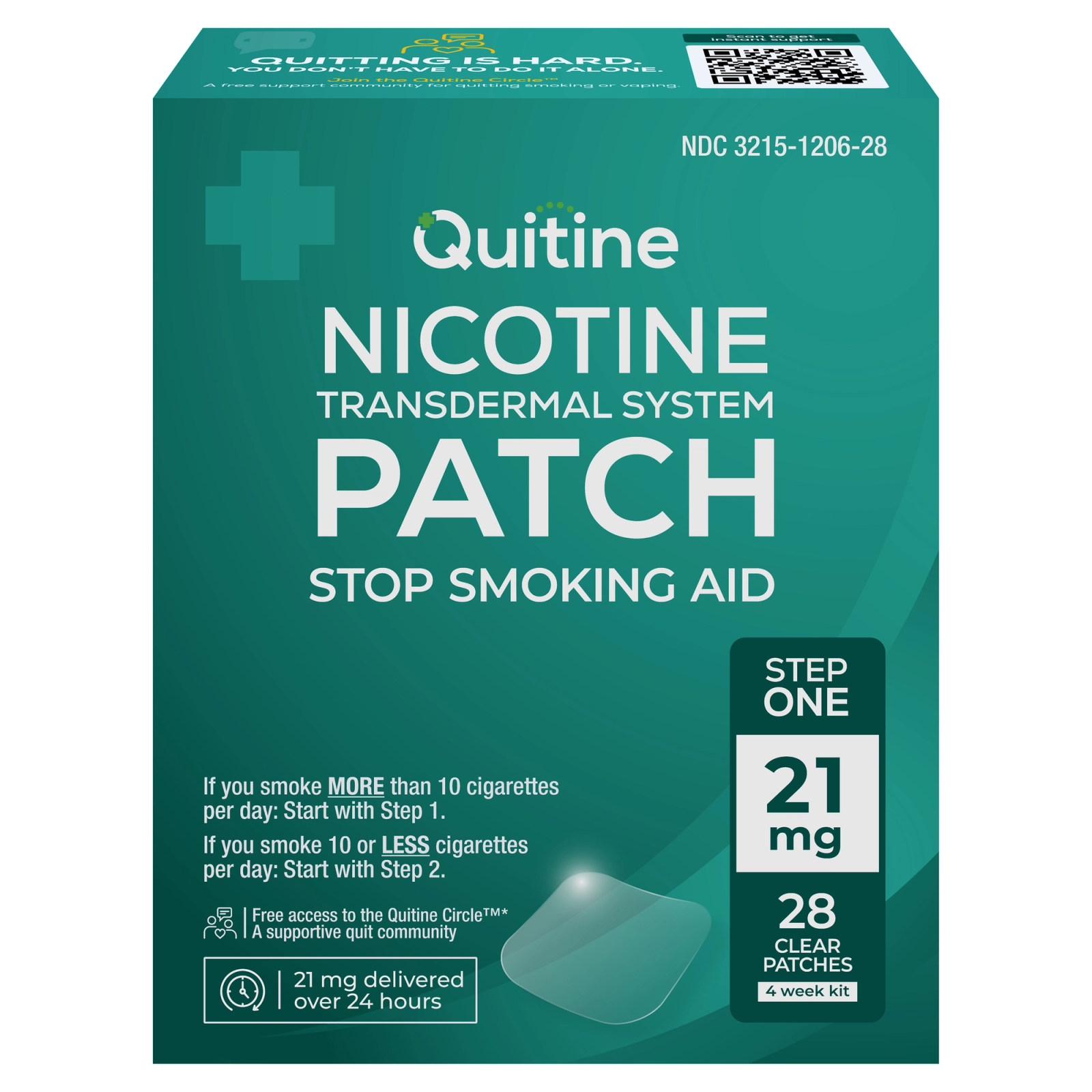
Description (Quitine Nicotine Patches Step 1 21mg 28 Pieces):
28 patches (4-week kit)
Start here if you smoke or vape within 30 minutes of waking, or if you smoke more than 10 cigarettes a day. You can combine the patches with 4 mg gum or lozenges when a craving breaks through.
Quitine nicotine patches are an FDA-regulated stop-smoking aid. Each patch delivers a steady amount of nicotine through the skin over a full 24 hours. You put one patch on in the morning on clean, dry skin. It stays in place through the day so the nicotine stays even while you work on the habits that go with smoking or vaping.
How to use
- Choose clean, dry, hairless skin on your upper arm, chest, or back. Skip lotions or oils before you apply the patch.
- Peel the liner and press the patch firmly for 10 to 20 seconds. Smooth the edges so it holds.
- Wear the patch for 24 hours. It is made for all-day use during regular activities.
- Remove the patch after 24 hours and put a new one on a different skin site. Rotate the spot each day to keep the skin comfortable.
Stop use if skin irritation occurs. See the package directions.
2) Quitine Nicotine Patches Step 2 14mg 14 Pieces
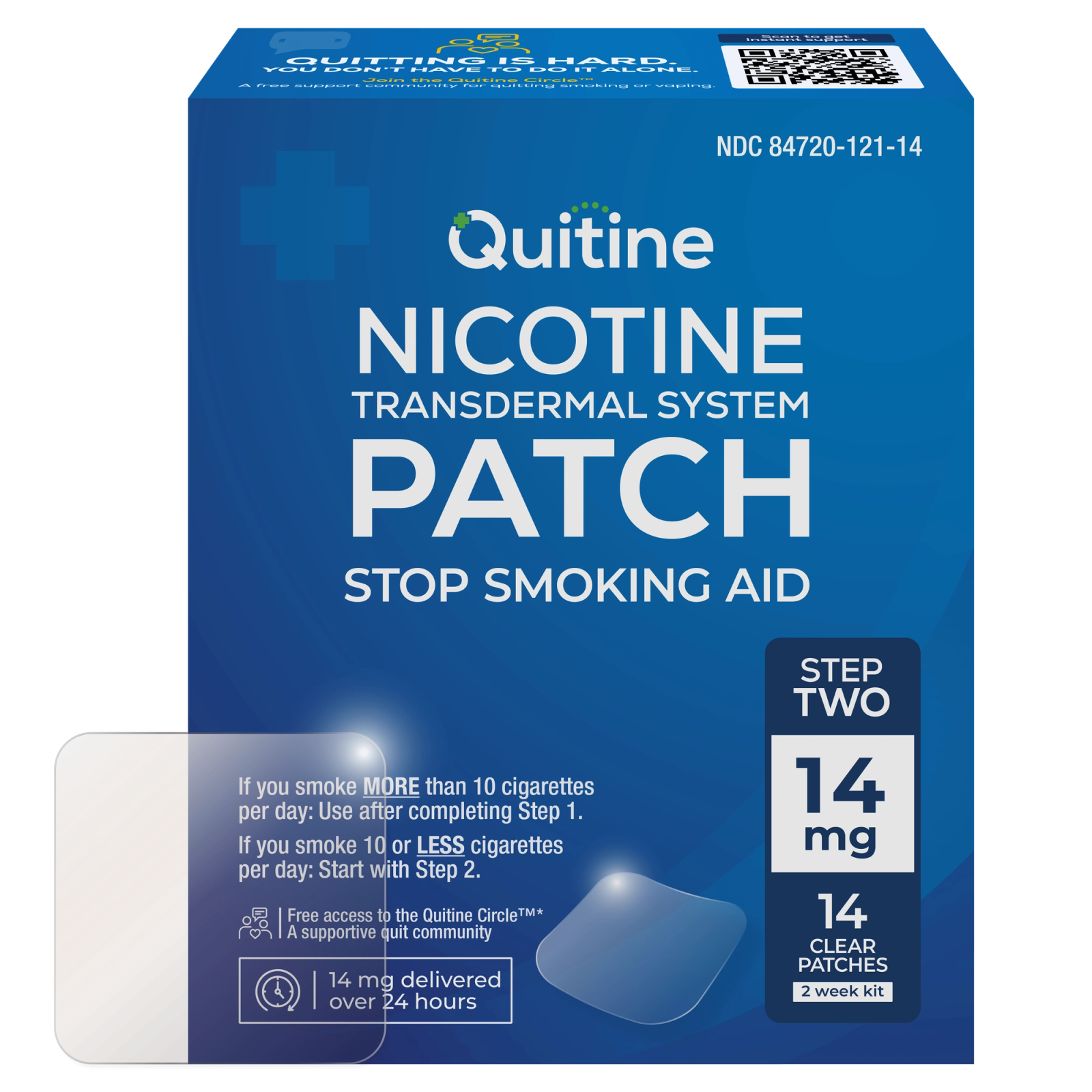
Description (Quitine Nicotine Patches Step 2 14mg 14 Pieces):
14 patches (2-week kit)
Start here if you smoke fewer than 10 cigarettes a day or vape lightly. You can also use these after you finish Step 1. Combine with 2 mg gum or lozenges if a craving breaks through.
Quitine nicotine patches are an FDA-regulated stop-smoking aid. Each patch delivers a steady amount of nicotine through the skin over 24 hours. You apply one patch each morning to clean, dry skin. It works in the background all day. There is no timing or counting required. You get consistent baseline support so you can focus on breaking the habit.
How to use
- Choose clean, dry, hairless skin on your upper arm, chest, or back. Skip lotions or oils before applying.
- Peel the liner and press the patch firmly for 10 to 20 seconds. Smooth the edges for a solid hold.
- Wear the patch for 24 hours. It is made for all-day wear, including everyday activities.
- Remove the patch after 24 hours and apply a new one to a different skin site. Rotate the site daily for comfort.
Stop use if skin irritation occurs. See the package directions for full details.
3) Quitine Nicotine Patches Step 3 7mg 14 Pieces
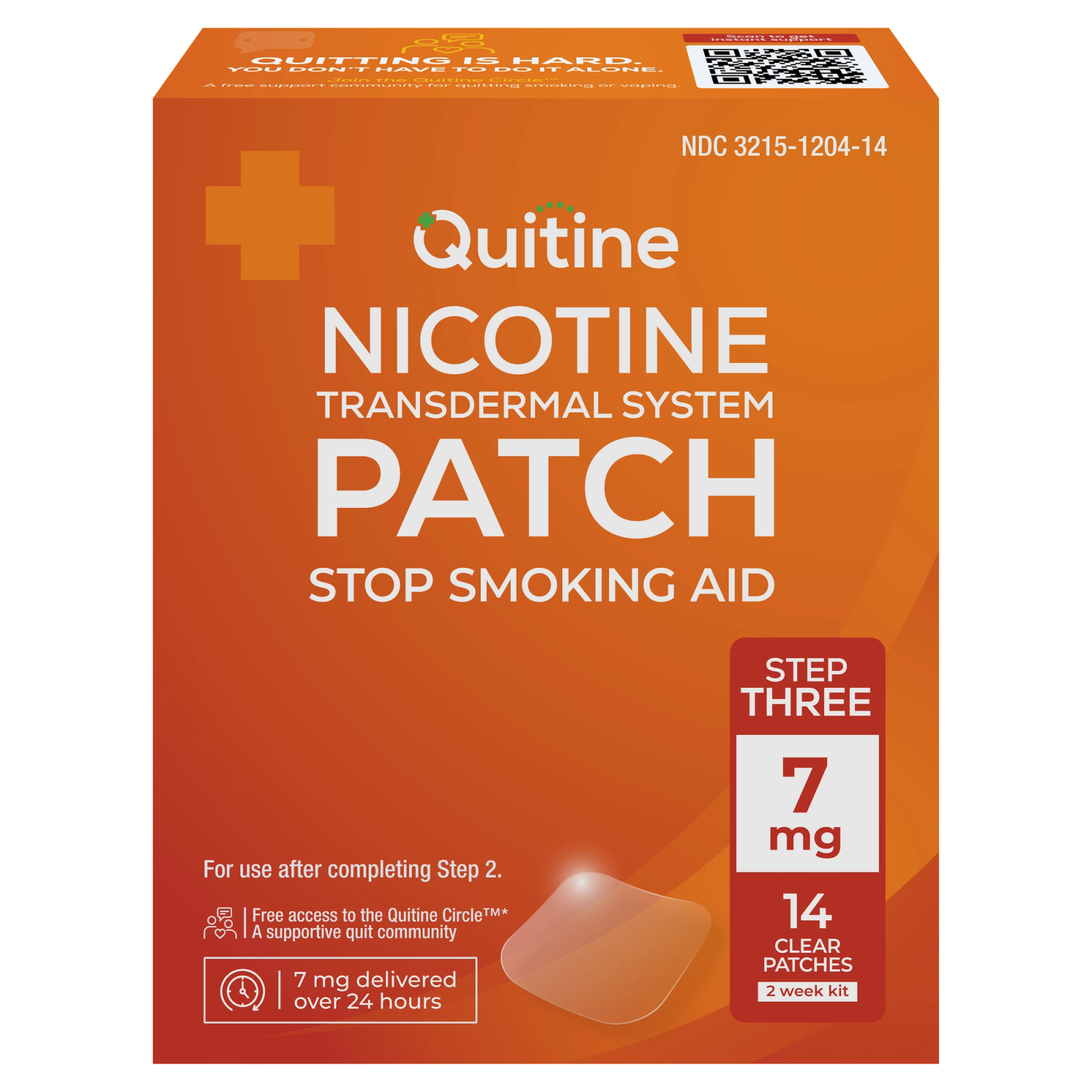
Description (Quitine Nicotine Patches Step 3 7mg 14 Pieces):
14 patches (2-week kit)
Use after you finish Step 2. This is the final taper. You can use the patches alone or add 2 mg gum or lozenges on harder days.
Quitine nicotine patches are an FDA-regulated stop-smoking aid. Each one delivers a steady amount of nicotine through the skin over 24 hours. You apply one patch every morning to clean, dry skin. The patch works in the background all day so you can focus on changing the habit itself.
How to use
- Choose a clean, dry, hairless area of skin on your upper arm, chest, or back. Skip any lotions or oils before you put the patch on.
- Peel the liner and press the patch firmly for 10 to 20 seconds. Smooth the edges so it stays in place.
- Wear the patch for a full 24 hours through everyday activities.
- After 24 hours, take it off and put a new patch on a different skin site. Rotate the location each day for comfort.
Stop use if skin irritation appears and follow the package directions.
FAQ
How long before a nicotine patch starts to help a beginner?
Skin starts taking in nicotine as soon as the patch is on. Most people do not feel a clear change for a couple of hours, and a steady level can take longer than that. Plan your quit morning with a slow start in mind. A short-acting nicotine lozenge or gum can cover the wait. Give the patch several days of honest, all-day use before you decide it is a poor fit.
Can I wear a nicotine patch if I still vape or smoke a little?
Label directions tell you to stop smoking when you start the patch. Using both can push nicotine too high and make you sick. Some clinics set a short, supervised overlap while a person cuts down. That is a clinician call, not a DIY extra patch or extra vape. If you slip, put the next patch on the next morning and get back on the plan rather than tossing the box.
Do nicotine patches help if I am quitting vaping, not cigarettes?
Yes. The patch replaces nicotine, not tobacco flavor. Vapers who use nicotine soon after waking often start on the same 21 mg step as heavier smokers. Device strength varies a lot, so match the step to how early and how often you vape, then use a nicotine gum or lozenge for sudden puffs you used to take out of boredom.
What should I do with leftover patches when I finish a step?
Keep unopened pouches for the next quit attempt only if they are still in date and stored cool and dry. Do not save used patches. Fold them, pouch them, and trash them. If you finished Step 1 early because nicotine cravings dropped fast, ask a pharmacist before you jump to zero. A planned Step 2 is usually kinder than an abrupt stop.
Is a patch enough, or do I need a program around it?
A patch can cut the physical crash. Many people still relapse from routine and stress. A written quit day, a step-down calendar, and a place to ask questions raise the odds that you finish the box. The Quitine Circle is built for that stretch. Products handle nicotine. People handle the 3 p.m. slump.
Get Your Personalized Quit Plan.
Read Also:

Ready to Quit or Just Cut Back?
If you're reading about nicotine, vaping, or smoking habits, chances are you're already thinking about making a change.
You don't have to figure it out alone. The Quitine Circle is our free support community, open to everyone quitting smoking or vaping. No purchase is required, and you do not need to use Quitine products to participate.
Inside the Quitine Circle you'll find:
The 90-Day Quit Program to guide your step down plan
A printable Quit Program Workbook to track progress
Practical tools for managing cravings and triggers
Support from others going through the same process
Quitting works best when you combine the right tools with the right structure. That's exactly what the Quitine system is built for.
Take our short quiz to see which Quitine Quit Kit fits your nicotine habits.

Not Sure Which Product Is Right for You?
Take our 2-minute Quit Quiz and get a personalized product recommendation and 90-day system based on your smoking or vaping habits.