
Nicotine patch use in non-smokers: medical risks explained

Nicotine patches are made only for people who already depend on nicotine from smoking or vaping. Non-smokers have no tolerance, so a standard patch can produce stronger effects such as nausea and dizziness along with a faster heart rate and the chance of new dependence.
Accidental or intentional use by someone who has never smoked offers no benefit and can lead to uncomfortable reactions. Quitine nicotine patches exist strictly as part of a structured quit smoking plan for those who need controlled nicotine support while they stop tobacco or vapes.Patch users may experience nicotine patch skin reactions, nicotine patch headaches and dizziness, nicotine patch withdrawal symptoms, or nicotine patch digestive issues, nausea and reflux. Understanding these effects can help support safer, more comfortable nicotine replacement use.
Get Support From the Quitine Community.
Why nicotine patches are not meant for non-smokers
Nicotine patches release a steady amount of nicotine through the skin to ease withdrawal in people who already use tobacco or nicotine products. Product labels and medical guidelines state they should not be given to non-smokers or occasional users. The body of a never-smoker has no built-up tolerance. As a result, the same dose that feels manageable to a daily smoker can feel much stronger and produce unwanted effects right away.
Health authorities and product information sheets list non-smokers as a group who should avoid these patches. The goal of the patch is to match and then slowly lower the nicotine dosage a smoker already receives. Giving that same delivery system to someone with zero baseline nicotine creates an unnecessary load on the heart, nervous system, and digestive tract. Research reviews of transdermal nicotine in people who do not smoke confirm that side effects appear more readily and that any experimental use belongs only inside carefully watched clinical trials.
Common medical risks and side effects in non-smokers
Without tolerance, non-smokers often feel the effects of a nicotine patch more intensely. The most frequent reactions include nausea and dizziness along with headache and a noticeable rise in heart rate. Skin redness or itching under the patch can also appear and may feel stronger than the mild irritation many smokers report.
Some people experience sleep changes or vivid dreams. Because the nicotine enters the bloodstream continuously, these sensations can last for hours. In people with no prior exposure, the cardiovascular response can feel more pronounced, with a faster pulse or a temporary rise in blood pressure. Most of these effects fade once the patch is removed, yet they serve as a clear signal that the product is not suited for non-users.
Mayo Clinic materials note that mild skin reactions are common with patches in general, but the overall system impact rises when the user has never smoked. The absence of tolerance means the body treats the incoming nicotine as a novel stimulant rather than a familiar substance being replaced.
Addiction and dependence risk for first-time users
Nicotine can create dependence. When a non-smoker wears a patch, the brain can begin to form new pathways that expect regular nicotine. Even though the delivery is slow, repeated exposure can create physical and psychological dependence where none existed before.
This risk differs from the situation of a smoker who is already dependent and uses the patch only to step down. A never-user starts from zero and may finish the course with a new habit instead of freedom from nicotine. Clinical reviews of non-smokers given transdermal nicotine for research purposes have noted that the potential for later tobacco or nicotine seeking has not been fully ruled out. For that reason, self-use outside a medical trial is strongly discouraged.
The safer path for anyone who does not currently smoke or vape is simply to stay free of nicotine products altogether. Adding nicotine through a nicotine patch introduces an avoidable risk of dependence that serves no medical purpose.
Overdose signs and what to do
Because non-smokers have little or no tolerance, the amount of nicotine in a standard patch can push some people toward overdose symptoms. Early signs often include nausea that worsens into vomiting, unusual weakness, cold sweat, or confusion. A rapid or irregular heartbeat can also appear. More severe cases can involve breathing difficulty or pale skin.
If a non-smoker applies a patch by accident or on purpose and begins to feel unwell, the first step is to remove the patch at once and wash the skin with plain water. Seek medical help right away if symptoms are more than mild. Children are especially sensitive, so patches must always stay out of reach. Even used patches still contain nicotine and can cause harm if handled or swallowed.
Special groups who face higher risk
Certain people should never use a nicotine patch if they do not already smoke. Pregnant individuals face added concerns because nicotine can affect the developing baby. Anyone with heart rhythm problems, recent heart events, or uncontrolled blood pressure needs medical clearance even if they are quitting. For a non-smoker these conditions make the patch especially unwise.
People with ongoing skin disorders or known allergies to adhesives also face higher chances of local reactions. Adolescents and young adults who have never used nicotine products have no reason to start. In every case the absence of prior tobacco use removes any justification for introducing nicotine through the skin.
Safer paths for people who actually need nicotine support
When someone does smoke or vape and wants to stop, nicotine patches form one proven part of a step-down plan. The key is matching the product to an existing habit rather than creating a new one. Combining a patch with oral forms such as nicotine gum or nicotine lozenges often gives better craving control while the dose is lowered over weeks.
Quitine nicotine gum and nicotine lozenges offer flexible options that many people use alongside or instead of patches. The full collection of nicotine replacement products lets users choose the form and strength that fits their daily pattern. A structured quit nicotine plan, rather than open-ended use, keeps the focus on becoming free of nicotine rather than simply switching sources.
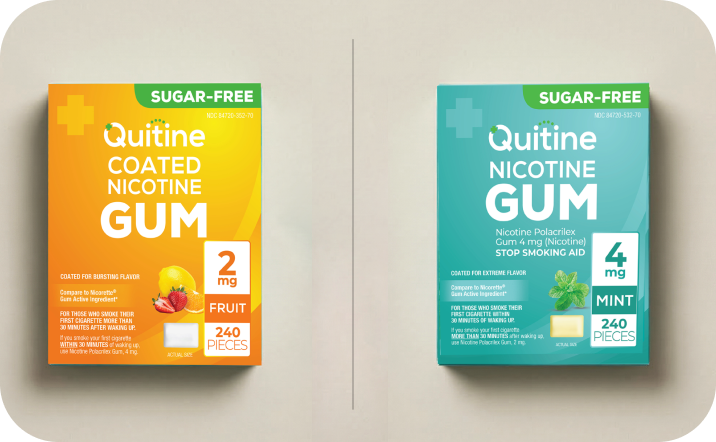
How Nicotine Gum Works
Nicotine gum delivers nicotine through the lining of your mouth as you chew. Unlike regular chewing gum, you need to use a specific "chew and park" technique to get the full effect.
Best for habit-triggered cravings
If you smoke or vape in response to specific triggers, after meals, during breaks, or when stressed, nicotine gum gives you something to do with your hands and mouth, which can help replace the physical habit.
Which Should You Choose?
The best choice depends on your personal preferences and smoking habits. If you miss the hand-to-mouth motion of smoking, gum might feel more natural. If you prefer something completely discreet, lozenges are a great option.Many people find that combining products, like using patches for all-day coverage and gum or lozenges for breakthrough cravings, gives them the best results.
Product Comparison
| Best For | Strength | |
|---|---|---|
| Nicotine Gum | Habit-triggered cravings | 2mg / 4mg |
| Nicotine Lozenges | Discreet craving relief | 2mg / 4mg |
| Nicotine Patches | All-day support | 21mg / 14mg / 7mg |
How Quitine supports proper quit plans without unnecessary risk
Quitine focuses on people who already use nicotine and want a clear path out. The patches come in stepped strengths that match common daily habits, and they pair naturally with nicotine gum and lozenges for breakthrough moments. Because the products are developed with pharmacist input, the dosing follows the principle of starting where the user is and then reducing over time.
The Quitine Circle gives free community support, progress tools, and real answers from people who understand the process. The 30-day money-back guarantee removes financial worry while someone tests the right combination. For anyone who is not currently smoking or vaping, the clear message remains the same: these tools are not needed and the risks outweigh any imagined benefit.
Discover Quitine and our best NRT products
Why Quitine?
Meet Mark and Oliver, the founders of Quitine. Mark has more than 40 years of experience as a pharmacist. His father’s long struggle with smoking shaped the work he does today. He has spent his career helping people leave cigarettes and vapes behind. Oliver brings deep experience in ecommerce, branding, product development, marketing, and logistics. Together they built Quitine to offer clear, practical nicotine replacement therapies that fit real daily life.
Our NRT products
Our pharmacist-formulated NRT products are made to support you while you change the habits that go with smoking or vaping.
Combination therapy for higher quit success
Research shows that combining a long-acting nicotine patch with a faster-acting form of NRT such as nicotine gum or nicotine lozenges can raise the chance of quitting smoking by 17 to 37 percent compared with using one product alone. At Quitine our nicotine patches deliver a steady amount of nicotine through the skin all day. Our nicotine gum and lozenges give you something to use when a craving hits. This dual approach, called NRT combination therapy, gives you more flexibility so you can stay comfortable while you change the habit.
Accessible pricing
We believe quitting should be within reach for everyone. We keep our therapies priced so more people can start without cutting corners on quality.
Personalized support
Quitting is personal, and so is the way we work with you. From the customer service team to the way each product is formulated, we stay with you through the process.
The Quitine Circle
The Quitine Circle is our free 90-day guided quit program and private support community. It is open to anyone quitting smoking or vaping and requires no purchase. It follows the same structured, pharmacist-backed approach that shapes our NRT products. You get short training modules, a practical quit workbook, weekly live Q and A sessions, and a moderated space with other people who are quitting, so you do not have to rely on willpower alone.
Discover which NRT is right for you
Not sure which product suits you best? Take our personalized quiz to find the NRT product that fits your needs. Take the Quiz
Real quitters. Real success.
See what our customers are saying about Quitine nicotine replacement therapy. Read Case Studies
The Quitine guarantee
Your satisfaction is covered. Learn more about our 30-day money-back promise. Learn More About Our Guarantee
Discover our best nicotine patches - Quitine
1) Quitine Nicotine Patches Step 1 21mg 28 Pieces
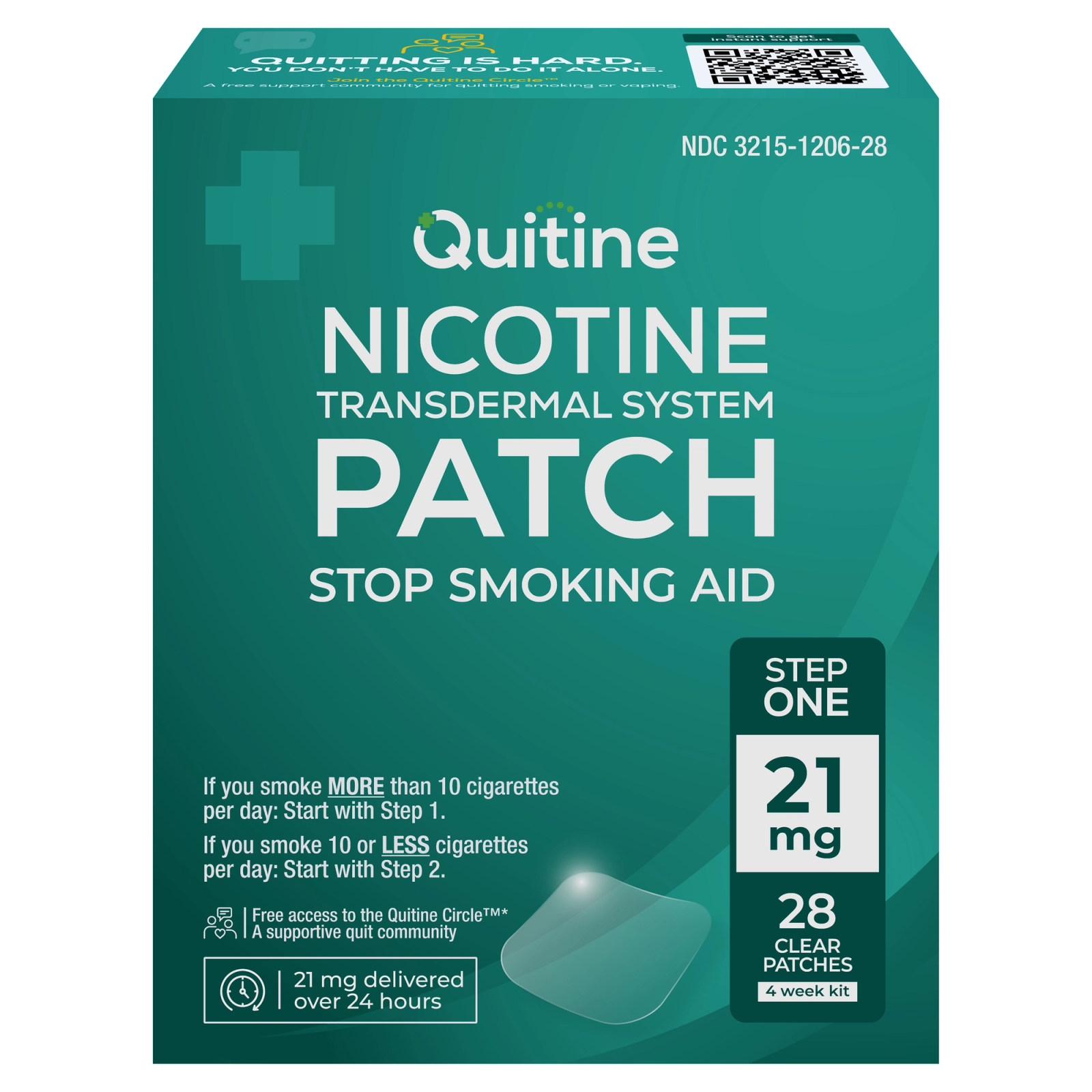
Description (Quitine Nicotine Patches Step 1 21mg 28 Pieces):
28 patches (4-week kit)
Start here if you smoke or vape within 30 minutes of waking, or if you smoke more than 10 cigarettes a day. You can combine the patches with 4 mg gum or lozenges when a craving breaks through.
Quitine nicotine patches are an FDA-regulated stop-smoking aid. Each patch delivers a steady amount of nicotine through the skin over a full 24 hours. You put one patch on in the morning on clean, dry skin. It stays in place through the day so the nicotine stays even while you work on the habits that go with smoking or vaping.
How to use
- Choose clean, dry, hairless skin on your upper arm, chest, or back. Skip lotions or oils before you apply the patch.
- Peel the liner and press the patch firmly for 10 to 20 seconds. Smooth the edges so it holds.
- Wear the patch for 24 hours. It is made for all-day use during regular activities.
- Remove the patch after 24 hours and put a new one on a different skin site. Rotate the spot each day to keep the skin comfortable.
Stop use if skin irritation occurs. See the package directions.
2) Quitine Nicotine Patches Step 2 14mg 14 Pieces
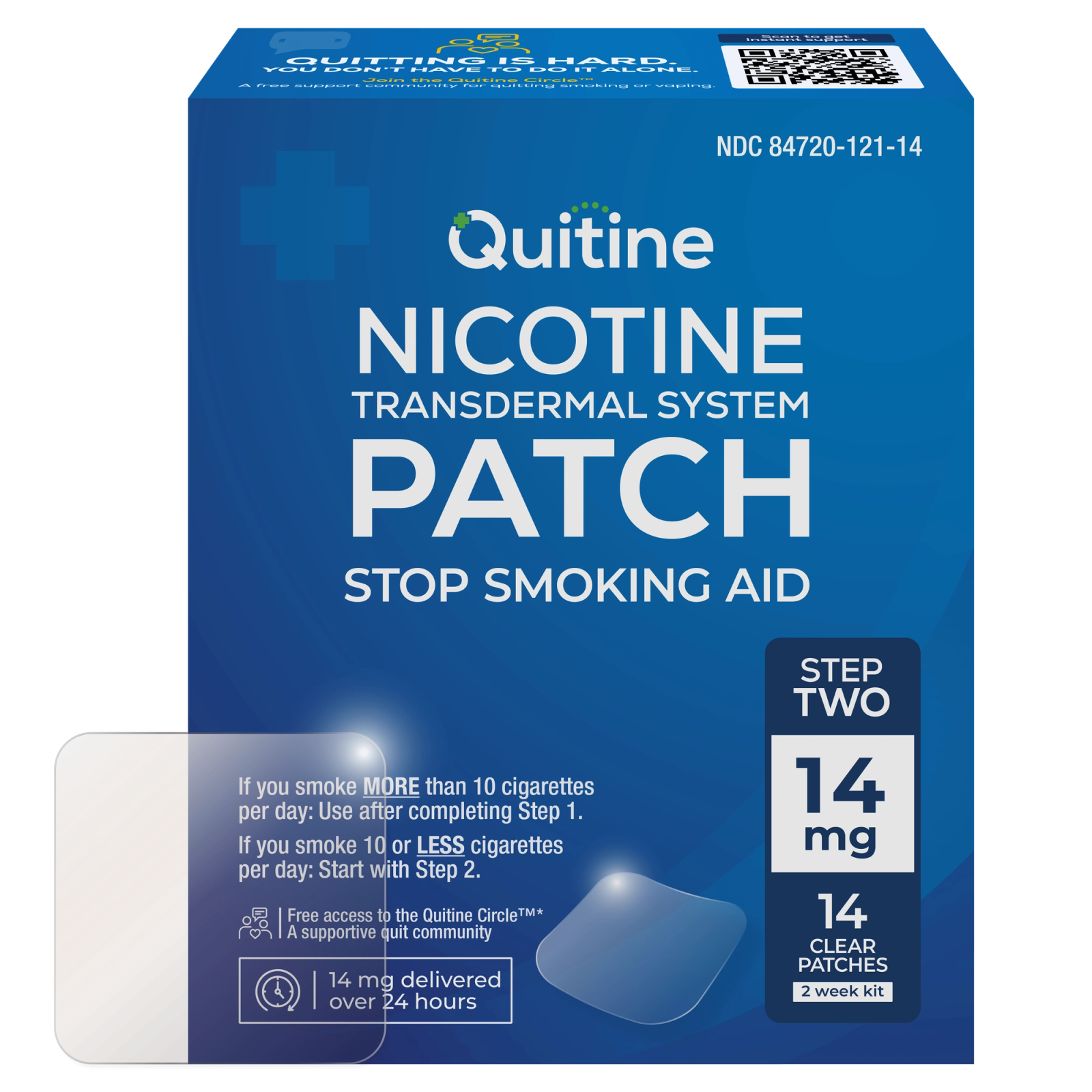
Description (Quitine Nicotine Patches Step 2 14mg 14 Pieces):
14 patches (2-week kit)
Start here if you smoke fewer than 10 cigarettes a day or vape lightly. You can also use these after you finish Step 1. Combine with 2 mg gum or lozenges if a craving breaks through.
Quitine nicotine patches are an FDA-regulated stop-smoking aid. Each patch delivers a steady amount of nicotine through the skin over 24 hours. You apply one patch each morning to clean, dry skin. It works in the background all day. There is no timing or counting required. You get consistent baseline support so you can focus on breaking the habit.
How to use
- Choose clean, dry, hairless skin on your upper arm, chest, or back. Skip lotions or oils before applying.
- Peel the liner and press the patch firmly for 10 to 20 seconds. Smooth the edges for a solid hold.
- Wear the patch for 24 hours. It is made for all-day wear, including everyday activities.
- Remove the patch after 24 hours and apply a new one to a different skin site. Rotate the site daily for comfort.
Stop use if skin irritation occurs. See the package directions for full details.
3) Quitine Nicotine Patches Step 3 7mg 14 Pieces
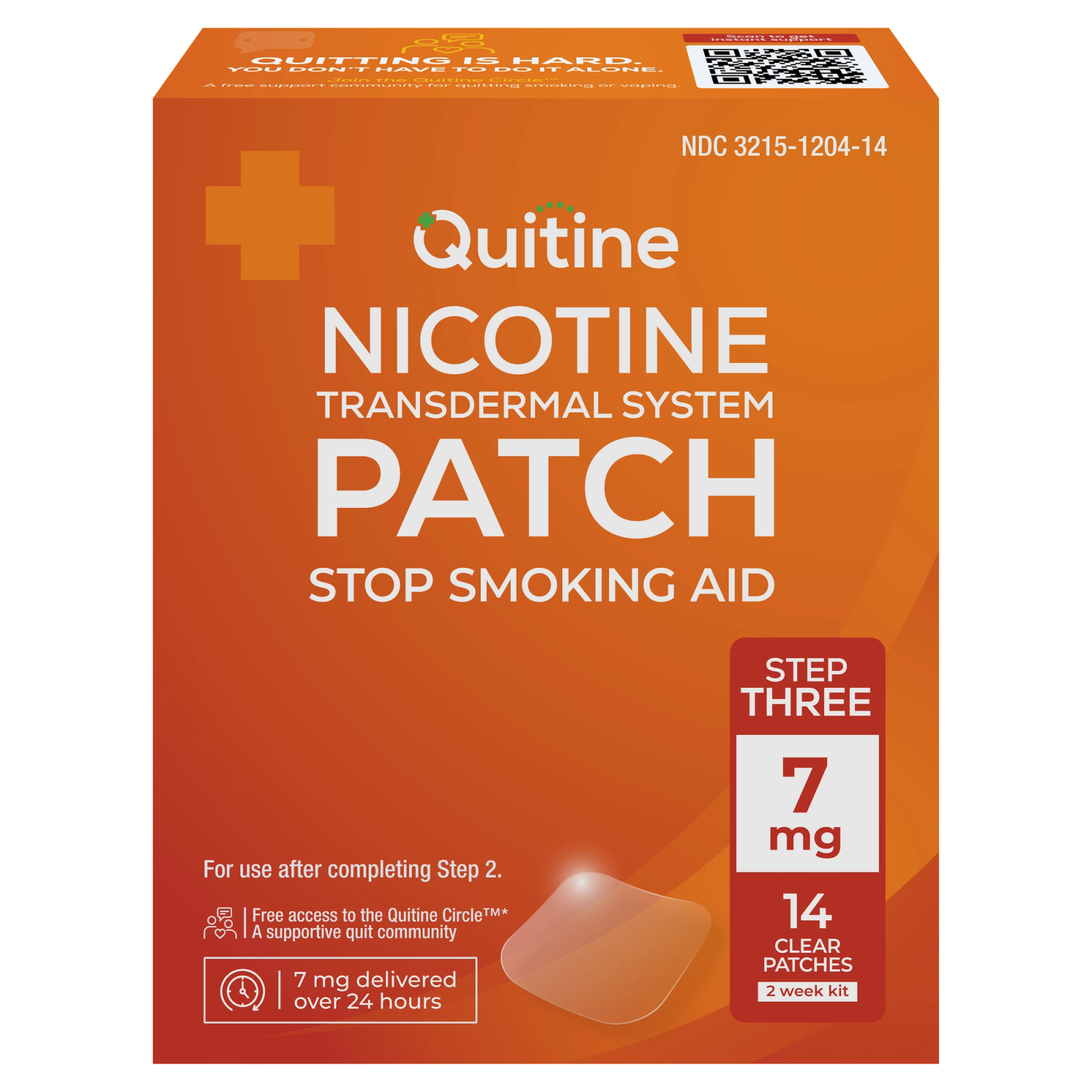
Description (Quitine Nicotine Patches Step 3 7mg 14 Pieces):
14 patches (2-week kit)
Use after you finish Step 2. This is the final taper. You can use the patches alone or add 2 mg gum or lozenges on harder days.
Quitine nicotine patches are an FDA-regulated stop-smoking aid. Each one delivers a steady amount of nicotine through the skin over 24 hours. You apply one patch every morning to clean, dry skin. The patch works in the background all day so you can focus on changing the habit itself.
How to use
- Choose a clean, dry, hairless area of skin on your upper arm, chest, or back. Skip any lotions or oils before you put the patch on.
- Peel the liner and press the patch firmly for 10 to 20 seconds. Smooth the edges so it stays in place.
- Wear the patch for a full 24 hours through everyday activities.
- After 24 hours, take it off and put a new patch on a different skin site. Rotate the location each day for comfort.
Stop use if skin irritation appears and follow the package directions.
FAQ
Why do non-smokers feel stronger side effects from a nicotine patch?
Non-smokers have never built tolerance to nicotine, so the steady dose from a patch hits the nervous system and heart more sharply. Common reactions such as nausea and dizziness appear more quickly and can feel more intense than the milder versions many smokers experience. A faster pulse and skin irritation under the patch can also stand out more. Removing the patch usually ends the symptoms, yet the experience shows why the nicotine product is reserved for people who already use nicotine.
Can a non-smoker become addicted to nicotine patches?
Yes. Nicotine remains capable of creating dependence even when delivered slowly through the skin. A person who starts with zero dependence can develop both physical and mental reliance after repeated exposure. This risk is higher than in smokers who use the patch only to reduce an existing habit. The safest choice for anyone who does not already smoke or vape is to avoid nicotine products completely and stay free of the substance.
What should someone do if a non-smoker puts on a nicotine patch by mistake?
Remove the patch immediately and wash the skin with water. Watch for signs such as nausea, dizziness, weakness, or a rapid heartbeat. If any of these appear or if the person feels unwell, contact a healthcare professional or poison control right away. Used patches still contain nicotine, so they must be disposed of safely and kept away from children and non-users at all times.
Are there any approved medical reasons for non-smokers to use nicotine patches?
Outside of tightly controlled research trials, no. Product labels and clinical guidelines list non-smokers as a group who should not use the patches. Experimental studies have tested nicotine in certain neurological or other conditions, but those uses stay inside medical supervision and are not available for self-treatment. For everyday life, the risks of side effects from nicotine and new dependence outweigh any unproven benefit.
How do proper nicotine replacement products help people who actually smoke or vape?
When someone already depends on nicotine, a structured step-down plan with nicotine patches, nicotine gum, or nicotine lozenges can ease nicotine withdrawal while the habit changes. The full range of nicotine replacement products lets users match the form and strength to their current use and then lower it over time. Support tools such as the free Circle Community and clear dosing schedules keep the focus on becoming free of nicotine rather than simply replacing one source with another.
Discover Your Best Quit Strategy.
Read Also:

Ready to Quit or Just Cut Back?
If you're reading about nicotine, vaping, or smoking habits, chances are you're already thinking about making a change.
You don't have to figure it out alone. The Quitine Circle is our free support community, open to everyone quitting smoking or vaping. No purchase is required, and you do not need to use Quitine products to participate.
Inside the Quitine Circle you'll find:
The 90-Day Quit Program to guide your step down plan
A printable Quit Program Workbook to track progress
Practical tools for managing cravings and triggers
Support from others going through the same process
Quitting works best when you combine the right tools with the right structure. That's exactly what the Quitine system is built for.
Take our short quiz to see which Quitine Quit Kit fits your nicotine habits.

Not Sure Which Product Is Right for You?
Take our 2-minute Quit Quiz and get a personalized product recommendation and 90-day system based on your smoking or vaping habits.