
Nicotine patches and mental fatigue

Mental fatigue is one of the first things many people notice when they quit cigarettes or vapes. Thinking feels slow. Words sit just out of reach. Work that used to take ten minutes now takes twenty. That fog is not a character flaw. It is a common part of nicotine withdrawal, and it often shows up with irritability and poor sleep.
A nicotine patch does not "wake the brain up" like a cup of coffee. It keeps a steady amount of nicotine in the body so the crash between smokes or puffs is smaller. That flatter line is why many people find it easier to think, plan, and stay on task during a quit.
Nicotine withdrawal can also affect physical and emotional responses. Factors such as nicotine patches and sweating, nicotine patches and alcohol consumption, and nicotine patches and emotional regulation can all influence how withdrawal feels from day to day.
Start the 90-Day Quit Challenge.
Why mental fatigue hits when nicotine drops
Nicotine hits nicotinic acetylcholine receptors in the brain. Those receptors help with attention and working memory. After years of smoking or vaping, the brain starts to expect that signal on a tight schedule. When the next cigarette or vape does not arrive, several things happen at once.
Dopamine dips. Motivation feels flat. Acetylcholine signaling falls off, so focus slips. Sleep often gets worse for a stretch, which makes the fog thicker the next day. Cleveland Clinic lists trouble concentrating, tiredness, and low mood among the usual withdrawal symptoms, alongside cravings and restlessness.
This is why a person can feel exhausted and wired at the same time. The body is missing a stimulant it used all day. The mind is also doing extra work: fighting urges, rewriting habits, and staying alert in places that used to include a smoke break. Researchers at the University of Wisconsin have called that extra load cessation fatigue. It is the worn-out feeling that comes from spending all day not smoking. A patch does not remove the work of changing smoking habits. It reduces the chemical swing that makes that work so draining.
Brain fog after quitting usually tracks the rest of withdrawal. Many people feel it within the first day. It often feels worse in the first few days, then eases over a few weeks as receptors reset. If focus is still very poor after that window, a clinician should take a look. Something else may be going on, such as poor sleep, low iron, depression, or a nicotine dose that does not match your old habit.
How a nicotine patch changes the fatigue picture
Nicotine patches are different from a cigarette, a vape, or even nicotine gum. You put it on once. Nicotine moves through the skin into the blood over many hours. There is no sharp spike and no sharp drop. That matters for mental fatigue.
The brain is not bouncing between "enough nicotine" and "not enough." Those swings are what make afternoon slumps feel so sharp for people who still smoke. You are also not lighting up to "think better," so you are not training the brain to treat focus as a reason to use tobacco. A patch leaves your hands and mouth free. That sounds small. It is not. A lot of mental energy during a quit goes into fighting the ritual, not just the chemical need.
Older lab work found that a nicotine patch reduced fatigue and inertia scores in people who had gone a few hours without smoking, and it sped up some word-finding tasks. A later review of patch studies in healthy adults found a modest lift in attention. Memory results were mixed. A patch is not a study drug. For people coming off tobacco, the main win is fewer withdrawal dips. For some, that also means less mid-task tiredness.
Cold turkey focus vs patch focus
Quitting cold turkey cuts nicotine all at once. For a light, recent habit, some people manage it. For a daily habit that has lasted years, the cognitive cost is often high. Difficulty concentrating is one of the core nicotine withdrawal symptoms listed in clinical guides. That is the moment many people reach for "just one" cigarette to finish an email or get through a meeting.
A patch keeps a baseline so you can practice being a non-smoker without the full chemical crash. You still have to change routines. You still have nicotine cravings. You just have more working memory left to deal with them.
A useful way to think about it:
- Cold turkey: fastest drop, strongest fog for many people, highest early relapse risk when work or family needs a clear head
- Patch alone: steady cover, fewer all-day dips, less help for sudden trigger cravings
- Patch plus a nicotine gum or nicotine lozenge: baseline plus a tool for the spike after coffee, a stressful call, or a drive home
- Patch plus a written plan and live support: the same chemical cover, with someone to talk to when focus is thin
That last pairing is what many quit smoking plans now treat as the default, not an extra.
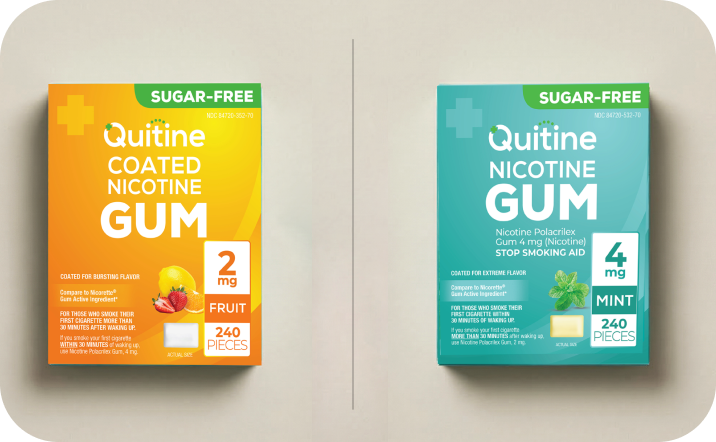
How Nicotine Gum Works
Nicotine gum delivers nicotine through the lining of your mouth as you chew. Unlike regular chewing gum, you need to use a specific "chew and park" technique to get the full effect.
Best for habit-triggered cravings
If you smoke or vape in response to specific triggers, after meals, during breaks, or when stressed, nicotine gum gives you something to do with your hands and mouth, which can help replace the physical habit.
Which Should You Choose?
The best choice depends on your personal preferences and smoking habits. If you miss the hand-to-mouth motion of smoking, gum might feel more natural. If you prefer something completely discreet, lozenges are a great option.Many people find that combining products, like using patches for all-day coverage and gum or lozenges for breakthrough cravings, gives them the best results.
Product Comparison
| Best For | Strength | |
|---|---|---|
| Nicotine Gum | Habit-triggered cravings | 2mg / 4mg |
| Nicotine Lozenges | Discreet craving relief | 2mg / 4mg |
| Nicotine Patches | All-day support | 21mg / 14mg / 7mg |
Why some people still feel tired on a patch
A nicotine patch can ease mental fatigue. It can also feel like it is not working, or like it is making you more tired. Both can be true, and the reason is usually one of these.
The dose is too low. If you used nicotine within 30 minutes of waking, or you smoked more than a pack-style amount each day, a light patch may leave you under-replaced. Withdrawal then continues. You feel foggy and worn out, and you blame the patch. The patch is just not covering enough.
The dose is too high. Nausea, a racing heart, headache, and a wired then crash feeling can follow an oversized patch, especially if you still smoke on top of it. Some people describe that crash as fatigue. It is closer to overstimulation.
Sleep is broken. Nicotine is a stimulant. A 24-hour patch can fuel vivid dreams or lighter sleep in some users. Poor sleep the night before looks like mental fatigue the next day. That is a sleep problem wearing a focus costume.
You are still fighting the habit with no backup. A patch does not replace the hand-to-mouth ritual. If every coffee, commute, and work break used to include nicotine, your brain still waits for that cue. The chemical need is quieter. The cue is not. That gap is where combination nicotine replacement therapy helps.
Something else is draining you. Quitting can unmask anxiety, low mood, anemia, thyroid issues, or long-standing sleep apnea. A patch will not fix those.
If focus stays poor after you have matched the step to your habit, check the basics: are you still using tobacco, is the patch staying on, are you changing the nicotine patch placement, and are you sleeping?
Sleep, overnight wear, and next-day fog
Sleep and mental fatigue are tightly linked during a quit. Nicotine delays sleep onset and fragments the night for many people who still smoke. After they quit, sleep can get worse before it gets better. Nighttime cravings, extra awakenings, and strange dreams are common in the first weeks. Medical News Today notes that nicotine is strongly tied to sleep disruption, and poor sleep then feeds daytime tiredness and weaker thinking.
A 24-hour nicotine patch can cut overnight cravings. That is useful if you used to wake up and smoke. For some people, leaving the patch on at night also means more vivid dreams. If that happens, a common fix is to take the patch off before bed and put a fresh one on in the morning. Ask a pharmacist or doctor before you change the wear schedule, especially if morning cravings are strong.
A few sleep habits help the patch do its job:
- Keep caffeine earlier in the day
- Get morning light and a short walk, even if energy is low
- Keep the bedroom cool and dark
- Do not pair the last hours of the evening with old smoking cues like the balcony or the car
As sleep settles, a lot of "patch fatigue" fades with it. You can read more on sleep and quitting smoking if nights are the main problem.
Combination NRT when a patch is not enough
Mental fatigue often spikes at predictable times: first email, after lunch, during a hard conversation, on the drive home. A patch is slow and steady. It is not built for a two-minute urge. That is why many people pair a daily patch with a fast oral product.
Nicotine gum gives you something to do with your mouth when a trigger hits. You chew, then park it. Nicotine lozenges dissolve without chewing, which helps if you need to stay quiet in a meeting or you have dental work. Neither should be used like candy.
Combination therapy is not "more nicotine for fun." It is a way to cover two different jobs. The patch holds the floor so you are not in withdrawal all day. Gum or a lozenge handles the spike so you do not smoke to think, calm down, or finish a task.
That pairing also lowers cessation fatigue, the worn-out feeling of white-knuckling every hour. When breakthrough cravings are shorter, the brain spends less of the day in fight mode. Focus has more room.
A simple rule: use the oral nicotine product for a real craving, not for boredom. If you are using many pieces a day and still feel foggy, the patch step may be too low. If you feel sick, the combined dose may be too high. The FAQ on nicotine replacement therapy walks through common setup questions.
Discover Quitine and our best NRT products
Why Quitine?
Meet Mark and Oliver, the founders of Quitine. Mark has more than 40 years of experience as a pharmacist. His father’s long struggle with smoking shaped the work he does today. He has spent his career helping people leave cigarettes and vapes behind. Oliver brings deep experience in ecommerce, branding, product development, marketing, and logistics. Together they built Quitine to offer clear, practical nicotine replacement therapies that fit real daily life.
Our NRT products
Our pharmacist-formulated NRT products are made to support you while you change the habits that go with smoking or vaping.
Combination therapy for higher quit success
Research shows that combining a long-acting nicotine patch with a faster-acting form of NRT such as nicotine gum or nicotine lozenges can raise the chance of quitting smoking by 17 to 37 percent compared with using one product alone. At Quitine our nicotine patches deliver a steady amount of nicotine through the skin all day. Our nicotine gum and lozenges give you something to use when a craving hits. This dual approach, called NRT combination therapy, gives you more flexibility so you can stay comfortable while you change the habit.
Accessible pricing
We believe quitting should be within reach for everyone. We keep our therapies priced so more people can start without cutting corners on quality.
Personalized support
Quitting is personal, and so is the way we work with you. From the customer service team to the way each product is formulated, we stay with you through the process.
The Quitine Circle
The Quitine Circle is our free 90-day guided quit program and private support community. It is open to anyone quitting smoking or vaping and requires no purchase. It follows the same structured, pharmacist-backed approach that shapes our NRT products. You get short training modules, a practical quit workbook, weekly live Q and A sessions, and a moderated space with other people who are quitting, so you do not have to rely on willpower alone.
Discover which NRT is right for you
Not sure which product suits you best? Take our personalized quiz to find the NRT product that fits your needs. Take the Quiz
Real quitters. Real success.
See what our customers are saying about Quitine nicotine replacement therapy. Read Case Studies
The Quitine guarantee
Your satisfaction is covered. Learn more about our 30-day money-back promise. Learn More About Our Guarantee
Discover our best nicotine patches - Quitine
1) Quitine Nicotine Patches Step 1 21mg 28 Pieces
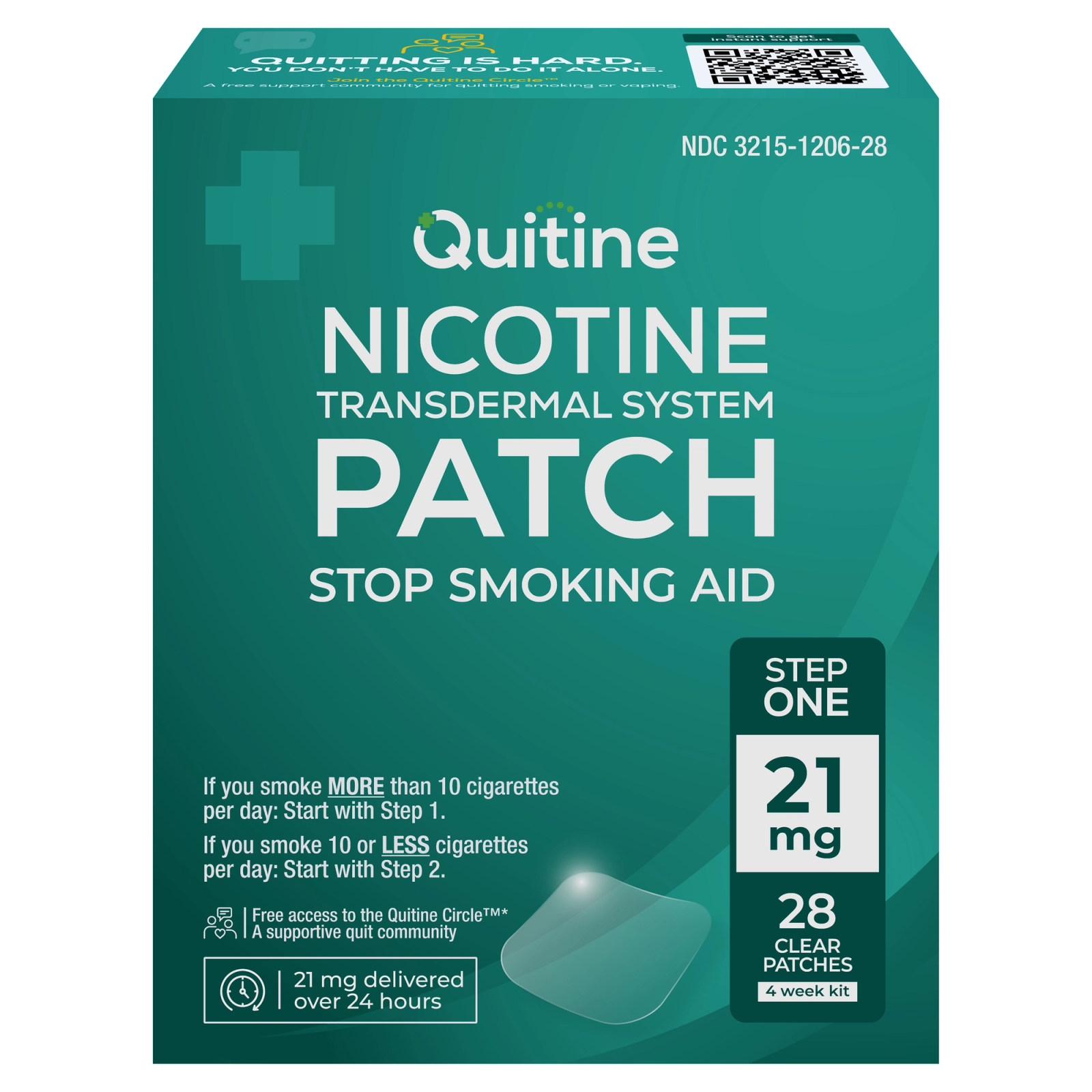
Description (Quitine Nicotine Patches Step 1 21mg 28 Pieces):
28 patches (4-week kit)
Start here if you smoke or vape within 30 minutes of waking, or if you smoke more than 10 cigarettes a day. You can combine the patches with 4 mg gum or lozenges when a craving breaks through.
Quitine nicotine patches are an FDA-regulated stop-smoking aid. Each patch delivers a steady amount of nicotine through the skin over a full 24 hours. You put one patch on in the morning on clean, dry skin. It stays in place through the day so the nicotine stays even while you work on the habits that go with smoking or vaping.
How to use
- Choose clean, dry, hairless skin on your upper arm, chest, or back. Skip lotions or oils before you apply the patch.
- Peel the liner and press the patch firmly for 10 to 20 seconds. Smooth the edges so it holds.
- Wear the patch for 24 hours. It is made for all-day use during regular activities.
- Remove the patch after 24 hours and put a new one on a different skin site. Rotate the spot each day to keep the skin comfortable.
Stop use if skin irritation occurs. See the package directions.
2) Quitine Nicotine Patches Step 2 14mg 14 Pieces
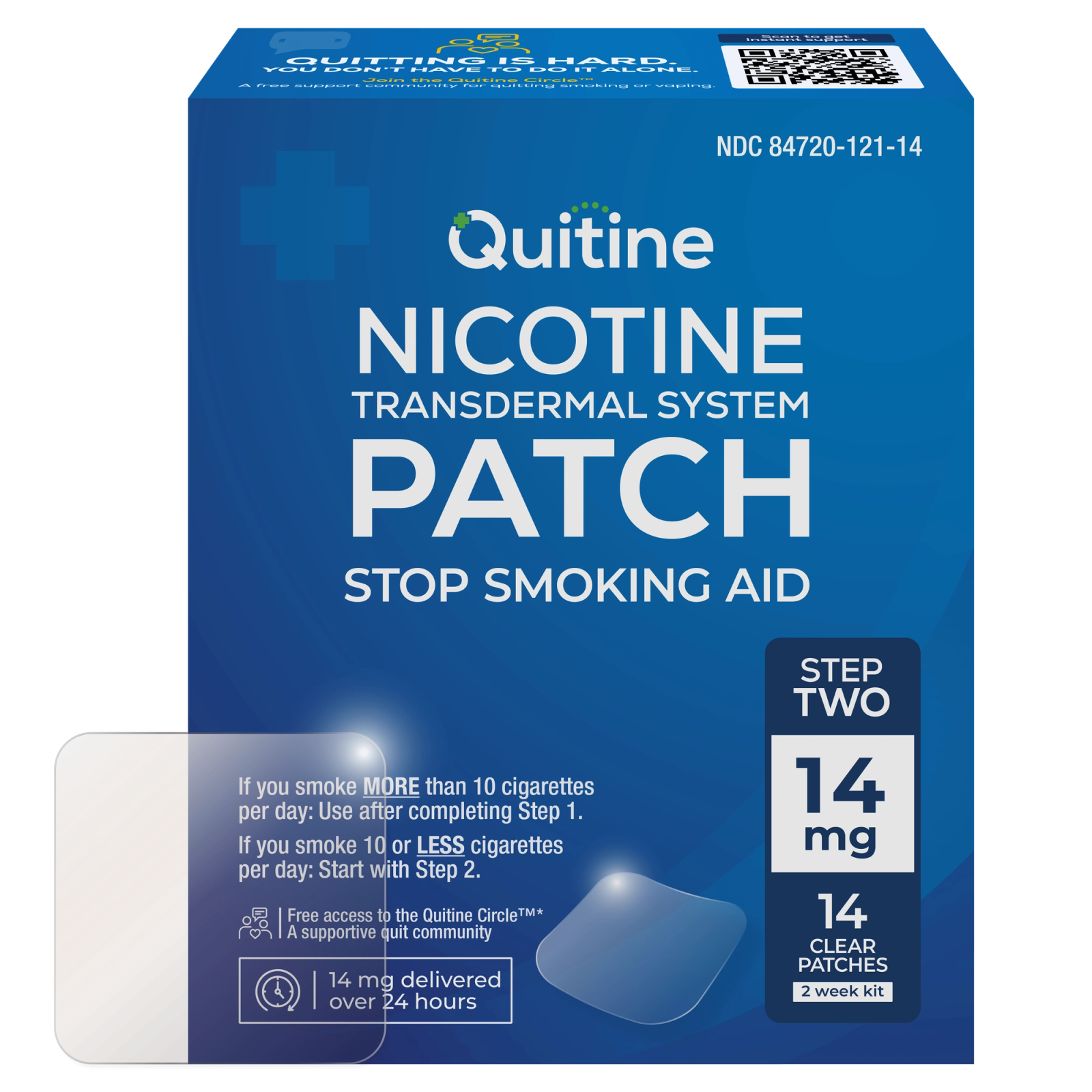
Description (Quitine Nicotine Patches Step 2 14mg 14 Pieces):
14 patches (2-week kit)
Start here if you smoke fewer than 10 cigarettes a day or vape lightly. You can also use these after you finish Step 1. Combine with 2 mg gum or lozenges if a craving breaks through.
Quitine nicotine patches are an FDA-regulated stop-smoking aid. Each patch delivers a steady amount of nicotine through the skin over 24 hours. You apply one patch each morning to clean, dry skin. It works in the background all day. There is no timing or counting required. You get consistent baseline support so you can focus on breaking the habit.
How to use
- Choose clean, dry, hairless skin on your upper arm, chest, or back. Skip lotions or oils before applying.
- Peel the liner and press the patch firmly for 10 to 20 seconds. Smooth the edges for a solid hold.
- Wear the patch for 24 hours. It is made for all-day wear, including everyday activities.
- Remove the patch after 24 hours and apply a new one to a different skin site. Rotate the site daily for comfort.
Stop use if skin irritation occurs. See the package directions for full details.
3) Quitine Nicotine Patches Step 3 7mg 14 Pieces
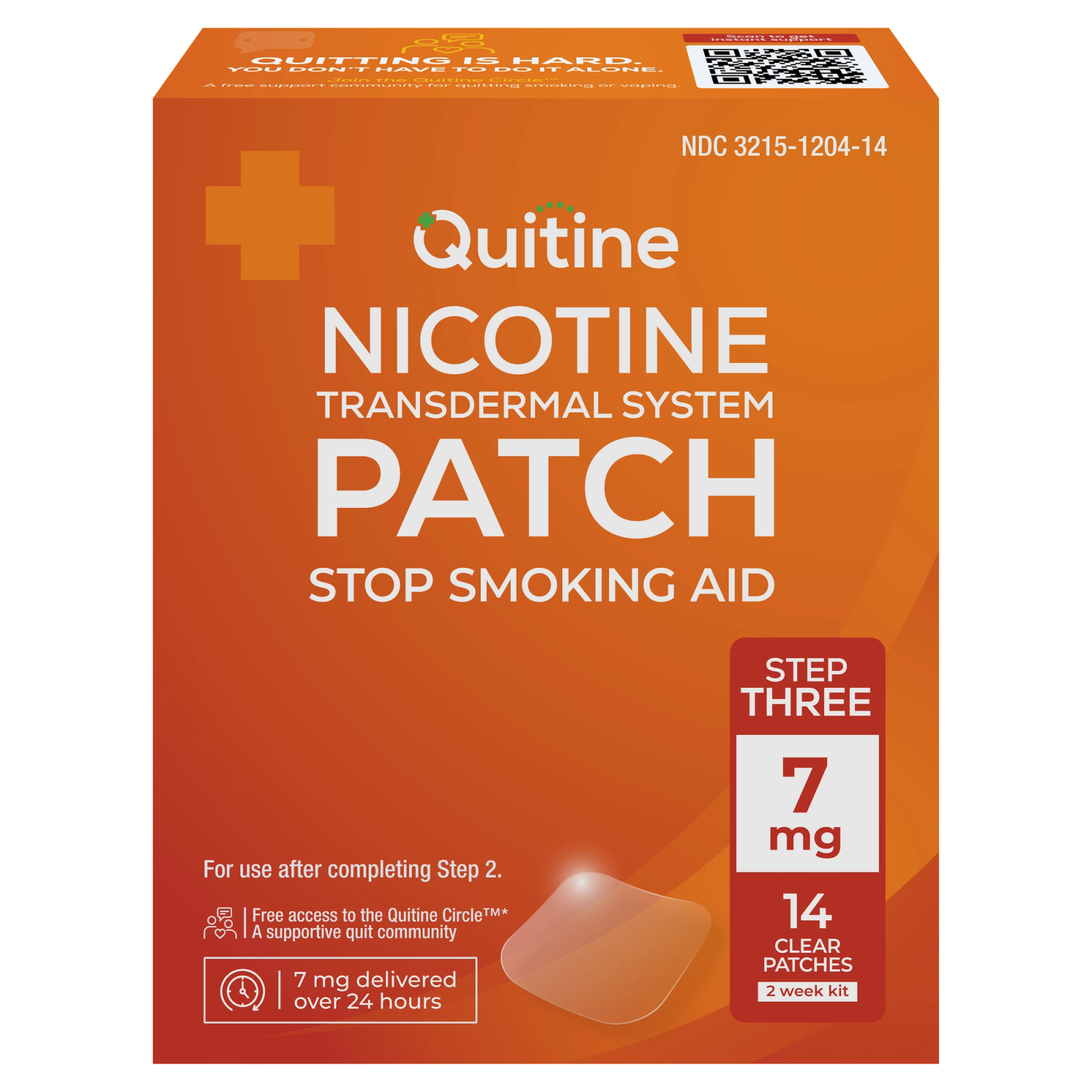
Description (Quitine Nicotine Patches Step 3 7mg 14 Pieces):
14 patches (2-week kit)
Use after you finish Step 2. This is the final taper. You can use the patches alone or add 2 mg gum or lozenges on harder days.
Quitine nicotine patches are an FDA-regulated stop-smoking aid. Each one delivers a steady amount of nicotine through the skin over 24 hours. You apply one patch every morning to clean, dry skin. The patch works in the background all day so you can focus on changing the habit itself.
How to use
- Choose a clean, dry, hairless area of skin on your upper arm, chest, or back. Skip any lotions or oils before you put the patch on.
- Peel the liner and press the patch firmly for 10 to 20 seconds. Smooth the edges so it stays in place.
- Wear the patch for a full 24 hours through everyday activities.
- After 24 hours, take it off and put a new patch on a different skin site. Rotate the location each day for comfort.
Stop use if skin irritation appears and follow the package directions.
Practical ways to protect focus while you wear a patch
A patch helps the chemistry. Daily habits to stop smoking still decide how clear your head feels.
Match the step to your mornings. If you reached for nicotine fast after waking, start higher. Under-dosing is a common reason people say "patches do nothing for my brain fog."
Put the patch on as part of a morning routine. Same time, clean skin, firm press. A patch that peels at noon leaves you under-covered during the hours you need to think.
Do not smoke or vape on the patch. Mixing sources raises side effects and keeps the old ritual alive. If the urge is that strong, add gum or a lozenge and review the steps.
Move your body a little. A short walk after meals is not a fitness program. It is a way to raise alertness without another stimulant.
Eat on a regular clock. Skipping meals plus withdrawal is a fast path to afternoon fog. Protein and water help more than extra sugar.
Protect the first two weeks at work if you can. Batch hard thinking for the time of day you already feel sharpest. Use oral NRT before known trigger blocks, not after you have already lost the thread.
Track two things only: sleep quality with nicotine patches and whether the fog is better, the same, or worse than yesterday. If it is worse and you have skin irritation, nausea, or pounding heartbeat, stop and get advice.
Mood and focus often move together. If anxiety or low mood is part of the picture, the note on mental health and quitting smoking is a useful companion to this one.
FAQ
Do nicotine patches cause mental fatigue or relieve it?
For most people who are quitting, a well-matched patch relieves mental fatigue by cutting the sharp drop that follows a missed cigarette or vape. The fog of early withdrawal is still real. It is usually milder than cold turkey. If the patch dose is too low, withdrawal continues and fatigue stays. If the dose is too high or sleep is wrecked, you can feel wrung out in a different way. The patch itself is not supposed to make thinking worse when the step fits the old habit.
How long does brain fog last if I use a nicotine patch?
Many people feel the worst of the fog in the first few days, then notice steadier thinking over the next few weeks as they stay on a plan. A patch does not freeze you in withdrawal. It makes the landing softer while receptors reset. If concentration is still very poor after that early stretch, look at sleep, dose, remaining tobacco use, and mood. A clinician can help sort patch issues from other causes.
Can I wear a nicotine patch at night if I feel exhausted in the morning?
Some people wear a 24-hour nicotine patch overnight so morning cravings and early fog are lighter. Others take it off at bedtime because vivid dreams wreck sleep, and bad sleep is its own kind of mental fatigue. If mornings are brutal without cover, keep the patch on and work on sleep habits. If dreams and broken nights are the bigger problem, ask a pharmacist about removing it before bed and putting a new one on at wake-up. Do not guess your way into two patches at once.
Is a patch better than gum for focus at work?
A patch is better at holding a quiet baseline so you are not thinking about nicotine every hour. Gum or a lozenge is better at the moment a craving arrives and your attention snaps off the task. For desk work, many people like the patch under a shirt plus a lozenge in a drawer. You stay discreet, and you still have a tool for the 3 p.m. slump. The better nicotine product is the one that covers both the floor and the spike.
Should I start a nicotine patch just to treat brain fog if I do not smoke?
No. A patch is a quit aid. Using nicotine when you have no dependence trades one problem for another. Early research in other conditions is interesting and still limited. If brain fog is your main complaint and you do not use tobacco, see a clinician. Sleep, mood, infection recovery, and medication side effects are far more common causes than a missing nicotine patch.
Become Part of the Quitine Circle.
Read Also:

Ready to Quit or Just Cut Back?
If you're reading about nicotine, vaping, or smoking habits, chances are you're already thinking about making a change.
You don't have to figure it out alone. The Quitine Circle is our free support community, open to everyone quitting smoking or vaping. No purchase is required, and you do not need to use Quitine products to participate.
Inside the Quitine Circle you'll find:
The 90-Day Quit Program to guide your step down plan
A printable Quit Program Workbook to track progress
Practical tools for managing cravings and triggers
Support from others going through the same process
Quitting works best when you combine the right tools with the right structure. That's exactly what the Quitine system is built for.
Take our short quiz to see which Quitine Quit Kit fits your nicotine habits.

Not Sure Which Product Is Right for You?
Take our 2-minute Quit Quiz and get a personalized product recommendation and 90-day system based on your smoking or vaping habits.