
Nicotine patches and future medical research directions

Nicotine patches give a steady dose of nicotine through the skin so you can quit smoking or vaping without the toxins in smoke. Research now looks at better patch materials, combination nicotine replacement, adaptive dosing, and trials of transdermal nicotine for attention and early memory loss. A pharmacist-built patch line already uses the same 21 mg, 14 mg, and 7 mg step-down many clinics recommend.
Emerging research also explores the nicotine patch placebo effect, growing interest in nicotine patch microdosing, and the fundamentals of what is a nicotine patch, including how transdermal nicotine is delivered gradually through the skin.
How nicotine patches work in the body
A nicotine patch is a thin adhesive film. Nicotine moves from the patch, through the outer skin, into small blood vessels, then into the bloodstream. The rise is slow compared with a cigarette or a vape. That slow rise is the point. You get a baseline of nicotine that blunts nicotine withdrawal, without the sharp spike that trains the brain to want another hit.
Most 24-hour patches come in labeled strengths:
- Step 1, 21 mg, for people who smoke or vape more and need a higher starting floor
- Step 2, 14 mg, as cravings ease
- Step 3, 7 mg, as the last taper before you stop nicotine
You put one patch on clean, dry skin on the upper arm, chest, or back. Press it for 10 to 20 seconds. Rotate the nicotine patch placement each day so the skin can recover. Many people wear the patch all day and overnight. If vivid dreams bother you, some take it off at night and put a new one on in the morning. Details on placement and wear time sit in how nicotine patches work.
The patch does not copy the hand-to-mouth habit. That keeps the routine simple. One decision in the morning. Breakthrough nicotine cravings tied to coffee, driving, or stress still show up for many people. That is why many plans pair a patch with a fast oral product such as nicotine gum or a nicotine lozenge.
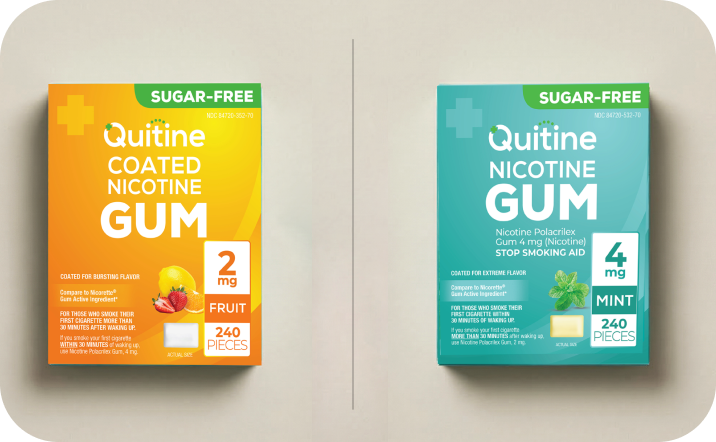
How Nicotine Gum Works
Nicotine gum delivers nicotine through the lining of your mouth as you chew. Unlike regular chewing gum, you need to use a specific "chew and park" technique to get the full effect.
Best for habit-triggered cravings
If you smoke or vape in response to specific triggers, after meals, during breaks, or when stressed, nicotine gum gives you something to do with your hands and mouth, which can help replace the physical habit.
Which Should You Choose?
The best choice depends on your personal preferences and smoking habits. If you miss the hand-to-mouth motion of smoking, gum might feel more natural. If you prefer something completely discreet, lozenges are a great option.Many people find that combining products, like using patches for all-day coverage and gum or lozenges for breakthrough cravings, gives them the best results.
Product Comparison
| Best For | Strength | |
|---|---|---|
| Nicotine Gum | Habit-triggered cravings | 2mg / 4mg |
| Nicotine Lozenges | Discreet craving relief | 2mg / 4mg |
| Nicotine Patches | All-day support | 21mg / 14mg / 7mg |
Why patches still sit at the front of quit care
Nicotine replacement therapy is one of the most studied stop-smoking tools we have. Patches, gum, lozenges, inhalers, and sprays all supply nicotine without tar, carbon monoxide, or the other chemicals in smoke. MedlinePlus notes that the forms work about equally well when people use them the right way, and that many people find gum and patches easier to use correctly.
Patches earn their place for practical reasons:
- You apply them once a day, so missed doses drop.
- Blood nicotine stays more even than with a cigarette.
- You can step the dose down on a calendar instead of guessing.
- You can add an oral nicotine product later without changing the morning patch.
They still need a plan around them. A patch treats the chemistry. Daily habits to stop smoking need practice. Product plus plan is what nicotine replacement therapy is built around.
Patches also travel well into research beyond quitting. Because the dose is known and the delivery is slow, labs can study nicotine itself, apart from smoke. That is why so many future medical research directions still start with the same transdermal format people already know.
Combination NRT and adaptive patch plans
A patch covers the background. A piece of nicotine gum or nicotine lozenge covers the spike. Cochrane reviewers have found that this combo, patch plus a fast-acting form, helps more people stay off cigarettes than a single form alone.
Adaptive care is the next layer. Instead of one fixed script for everyone, the plan changes if the first nicotine product is not enough. Reviews in the National Library of Medicine describe this as matching the first product to preference and early response, then adding or switching if cravings stay high. Some clinics start the patch before the quit date so nicotine levels are already stable on day one. Evidence on pre-quit patches is mixed, so many teams still start on quit day and adjust after the first week.
A simple adaptive loop looks like this:
- Start with a 24-hour patch at a strength that matches how soon you use nicotine after waking.
- Add gum or a lozenge for sudden cravings.
- If skin irritation or dreams show up, change wear time or site, not the whole plan.
- Step down only when background cravings have cooled.
That loop is already how many pharmacist-led kits are written. The science is not waiting for a new molecule. It is waiting for people to use the tools they already have, in the right order.
New materials that may change the patch itself
Classic patches use an adhesive matrix and a backing film. They work. They can also itch, peel in sweat, or leave residue. Materials science is trying to fix those weak points.
Electrospun nanofiber patches load nicotine into ultra-fine polymer fibers. Lab work with polyvinyl alcohol fibers has shown a controlled release pattern over several hours. The idea is a thinner film that still holds a dose and sits flatter on the skin.
Microneedle arrays are another track. Tiny tips pierce only the outer skin barrier. They are being tested across many drugs, from vitamins to pain medicines. No nicotine microneedle product is a routine quit tool yet. Reviews in journals such as the Journal of Controlled Release still flag dose size, manufacturing, and regulation as open problems. The payoff, if those problems close, would be faster onset without a needle and less waste of nicotine sitting on the skin surface.
Broader transdermal drug delivery reviews still list nicotine as one of the products that taught the field how a skin patch can work at scale. Newer strategies, peptides, liposomes, and physical enhancers, aim to move more drugs through the same barrier with less irritation. A 2026 review in Chinese Chemical Letters maps those strategies and notes that nicotine remains one of the most studied transdermal drugs in clinical trial records.
For someone quitting this month, none of that replaces a licensed 21 mg, 14 mg, or 7 mg patch. It does explain why brands keep refining adhesives, clear films, and residue. Comfort is not cosmetic. A patch that stays on is a patch you actually wear.
Transdermal nicotine outside smoking cessation
Nicotine binds nicotinic acetylcholine receptors in the brain. Those receptors help attention, some forms of memory, and the release of other chemical messengers. When smoke is out of the picture, researchers ask a different question. Can a clean, measured patch help brains that are short on that signaling?
Small trials and a meta-analysis in healthy adults have pointed to better attention with transdermal nicotine. Memory results have been less consistent. That pattern, clearer on attention than on memory, shows up again in early work on mild cognitive impairment.
The Memory Improvement Through Nicotine Dosing (MIND) study is the large test of that idea. It enrolls adults with mild cognitive impairment and compares a nicotine patch with a placebo patch over a long stretch, with a slow rise toward a 21 mg daytime dose. The National Institute on Aging and the Alzheimer’s Drug Discovery Foundation have backed the work. Results will tell us whether daily patches can move real-world thinking and function, not just lab scores.
A six-month pilot in people with amnestic mild cognitive impairment found gains on attention and some memory tasks, with good tolerability in people who did not smoke. Clinician global ratings did not move as clearly. That is why the bigger MIND trial matters. A change on a lab task may not match a change in daily life.
Other brain conditions have been less kind to the patch. A multicenter trial in early Parkinson’s disease found that a year of transdermal nicotine did not slow motor decline. Skin reactions were common. That result is useful in its own way. It tells teams not to treat every neurology idea as a new quit-patch indication.
Work on receptor subtypes is also moving. Papers on α7 and α5 nicotinic receptors ask whether future drugs can keep the attention benefit and drop the addiction risk. Those drugs, if they arrive, would sit beside patches, not inside them. For now, the licensed patch is still the cleanest way to study nicotine in people.
What other quit trials mean for the patch
Quit science is crowded. Some recent trials pit patches against newer ideas. A small randomized study of high-dose psilocybin plus counseling reported more six-month abstinence than a nicotine patch arm. That work is early. It needs larger trials, careful screening, and a regulatory path that does not exist for routine quit care today.
Living reviews of nicotine vapes have also reported higher quit rates than NRT in some adult trials. That finding does not make a vape a licensed stop-smoking medicine in the same class as a patch. Dual use, long-term nicotine, and product quality remain open issues. For many people, a patch is still the product they can buy, dose, and taper with a pharmacist’s map.
Nicotine patches will not win every head-to-head study. They remain widely available, well understood, and easy to combine with counseling and oral NRT. Future care is likely to keep the patch as the baseline layer and add faster or more personal tools around it.
Personal dosing, genetics, and wearable monitors
People do not clear nicotine at the same speed. Genes that affect CYP2A6, the main enzyme that breaks nicotine down, change how long a dose lasts. Fast metabolizers may feel a standard 21 mg patch fade sooner. Slow metabolizers may feel the same patch as too strong.
A research agenda published in the National Library of Medicine calls for a continuous nicotine monitor, a wearable that tracks nicotine in the body over time. The goal is to see the real curve each person gets from a patch, gum, or new nicotine product. If that device works, dose could follow the person instead of the label alone.
Until then, personal dosing is still analog:
- Match starting strength to how soon you need nicotine after waking.
- Watch skin, sleep, and leftover cravings in the first week.
- Add a fast oral nicotine product rather than stacking two patches.
- Step down when the day feels steady, not on a rigid calendar that ignores how you feel.
A 90-day quit quiz is one way to turn those rules into a kit instead of a guess. Patent filings also show vaccines, antibodies that bind nicotine in the blood, 5-HT2C agents, and cannabinoid combos. Most of that work is early. Combination with existing NRT is a common design choice, because a product that can sit next to a patch is easier to test than a product that must replace it.
Discover Quitine and our best NRT products
Why Quitine?
Meet Mark and Oliver, the founders of Quitine. Mark has more than 40 years of experience as a pharmacist. His father’s long struggle with smoking shaped the work he does today. He has spent his career helping people leave cigarettes and vapes behind. Oliver brings deep experience in ecommerce, branding, product development, marketing, and logistics. Together they built Quitine to offer clear, practical nicotine replacement therapies that fit real daily life.
Our NRT products
Our pharmacist-formulated NRT products are made to support you while you change the habits that go with smoking or vaping.
Combination therapy for higher quit success
Research shows that combining a long-acting nicotine patch with a faster-acting form of NRT such as nicotine gum or nicotine lozenges can raise the chance of quitting smoking by 17 to 37 percent compared with using one product alone. At Quitine our nicotine patches deliver a steady amount of nicotine through the skin all day. Our nicotine gum and lozenges give you something to use when a craving hits. This dual approach, called NRT combination therapy, gives you more flexibility so you can stay comfortable while you change the habit.
Accessible pricing
We believe quitting should be within reach for everyone. We keep our therapies priced so more people can start without cutting corners on quality.
Personalized support
Quitting is personal, and so is the way we work with you. From the customer service team to the way each product is formulated, we stay with you through the process.
The Quitine Circle
The Quitine Circle is our free 90-day guided quit program and private support community. It is open to anyone quitting smoking or vaping and requires no purchase. It follows the same structured, pharmacist-backed approach that shapes our NRT products. You get short training modules, a practical quit workbook, weekly live Q and A sessions, and a moderated space with other people who are quitting, so you do not have to rely on willpower alone.
Discover which NRT is right for you
Not sure which product suits you best? Take our personalized quiz to find the NRT product that fits your needs. Take the Quiz
Real quitters. Real success.
See what our customers are saying about Quitine nicotine replacement therapy. Read Case Studies
The Quitine guarantee
Your satisfaction is covered. Learn more about our 30-day money-back promise. Learn More About Our Guarantee
Discover our best nicotine patches - Quitine
1) Quitine Nicotine Patches Step 1 21mg 28 Pieces
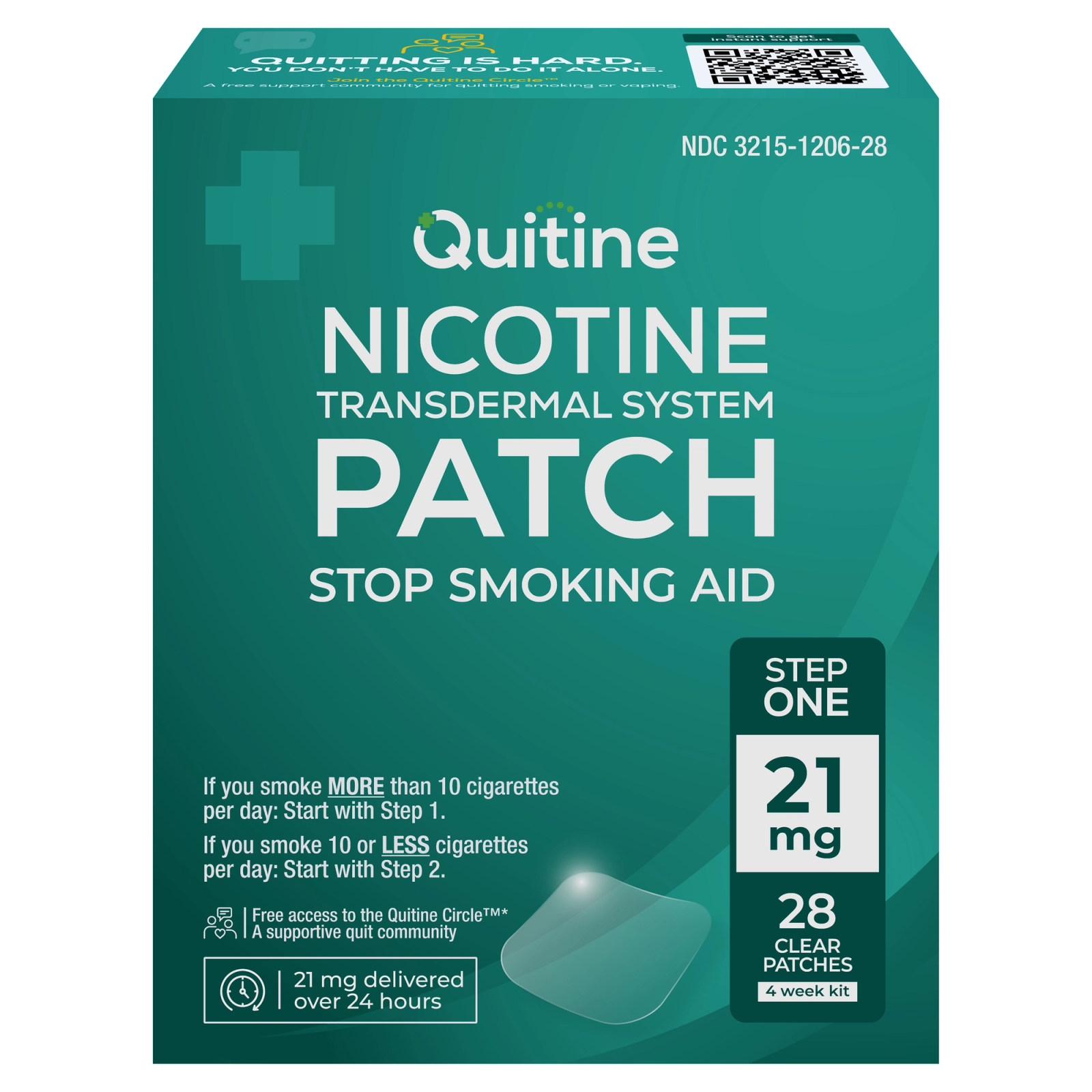
Description (Quitine Nicotine Patches Step 1 21mg 28 Pieces):
28 patches (4-week kit)
Start here if you smoke or vape within 30 minutes of waking, or if you smoke more than 10 cigarettes a day. You can combine the patches with 4 mg gum or lozenges when a craving breaks through.
Quitine nicotine patches are an FDA-regulated stop-smoking aid. Each patch delivers a steady amount of nicotine through the skin over a full 24 hours. You put one patch on in the morning on clean, dry skin. It stays in place through the day so the nicotine stays even while you work on the habits that go with smoking or vaping.
How to use
- Choose clean, dry, hairless skin on your upper arm, chest, or back. Skip lotions or oils before you apply the patch.
- Peel the liner and press the patch firmly for 10 to 20 seconds. Smooth the edges so it holds.
- Wear the patch for 24 hours. It is made for all-day use during regular activities.
- Remove the patch after 24 hours and put a new one on a different skin site. Rotate the spot each day to keep the skin comfortable.
Stop use if skin irritation occurs. See the package directions.
2) Quitine Nicotine Patches Step 2 14mg 14 Pieces
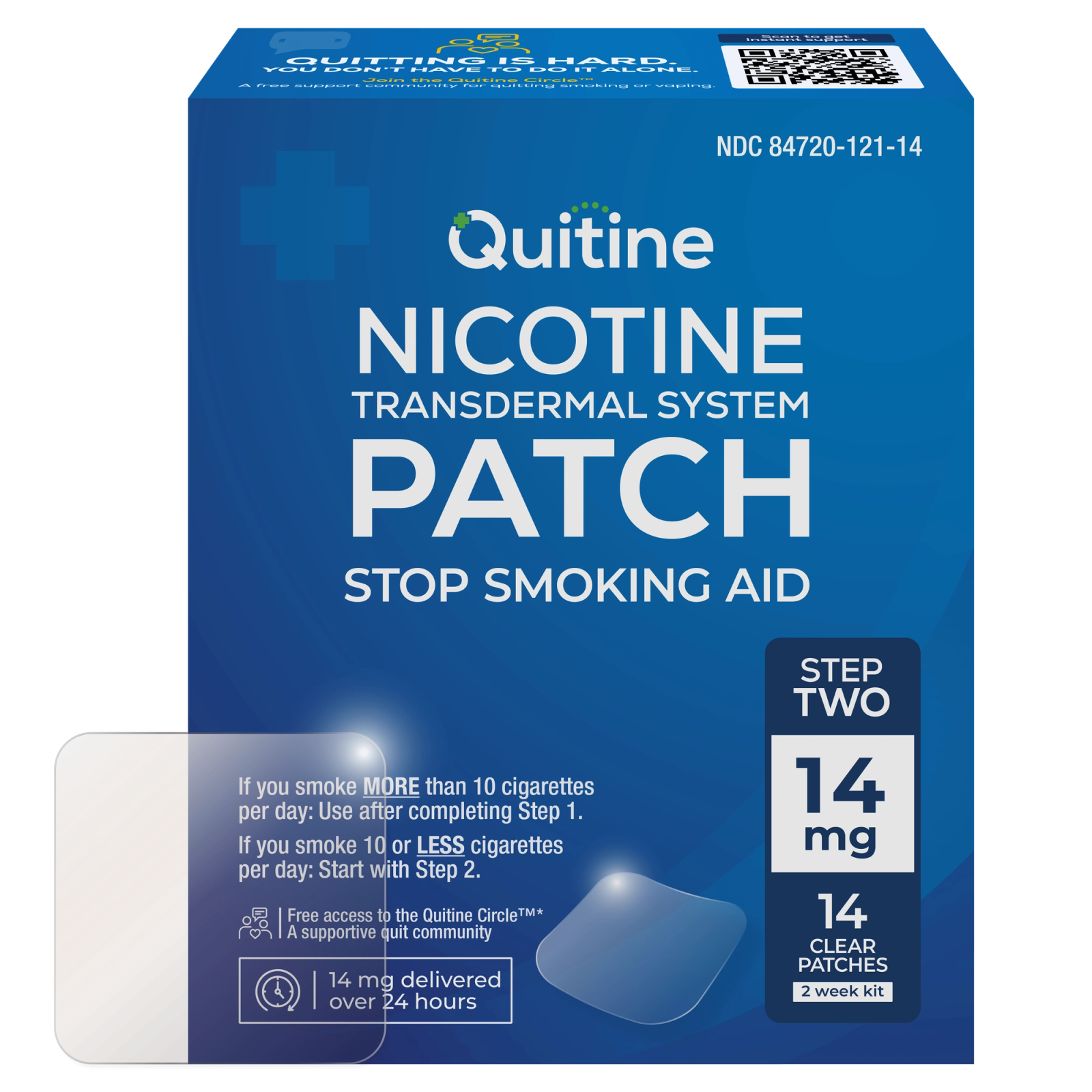
Description (Quitine Nicotine Patches Step 2 14mg 14 Pieces):
14 patches (2-week kit)
Start here if you smoke fewer than 10 cigarettes a day or vape lightly. You can also use these after you finish Step 1. Combine with 2 mg gum or lozenges if a craving breaks through.
Quitine nicotine patches are an FDA-regulated stop-smoking aid. Each patch delivers a steady amount of nicotine through the skin over 24 hours. You apply one patch each morning to clean, dry skin. It works in the background all day. There is no timing or counting required. You get consistent baseline support so you can focus on breaking the habit.
How to use
- Choose clean, dry, hairless skin on your upper arm, chest, or back. Skip lotions or oils before applying.
- Peel the liner and press the patch firmly for 10 to 20 seconds. Smooth the edges for a solid hold.
- Wear the patch for 24 hours. It is made for all-day wear, including everyday activities.
- Remove the patch after 24 hours and apply a new one to a different skin site. Rotate the site daily for comfort.
Stop use if skin irritation occurs. See the package directions for full details.
3) Quitine Nicotine Patches Step 3 7mg 14 Pieces
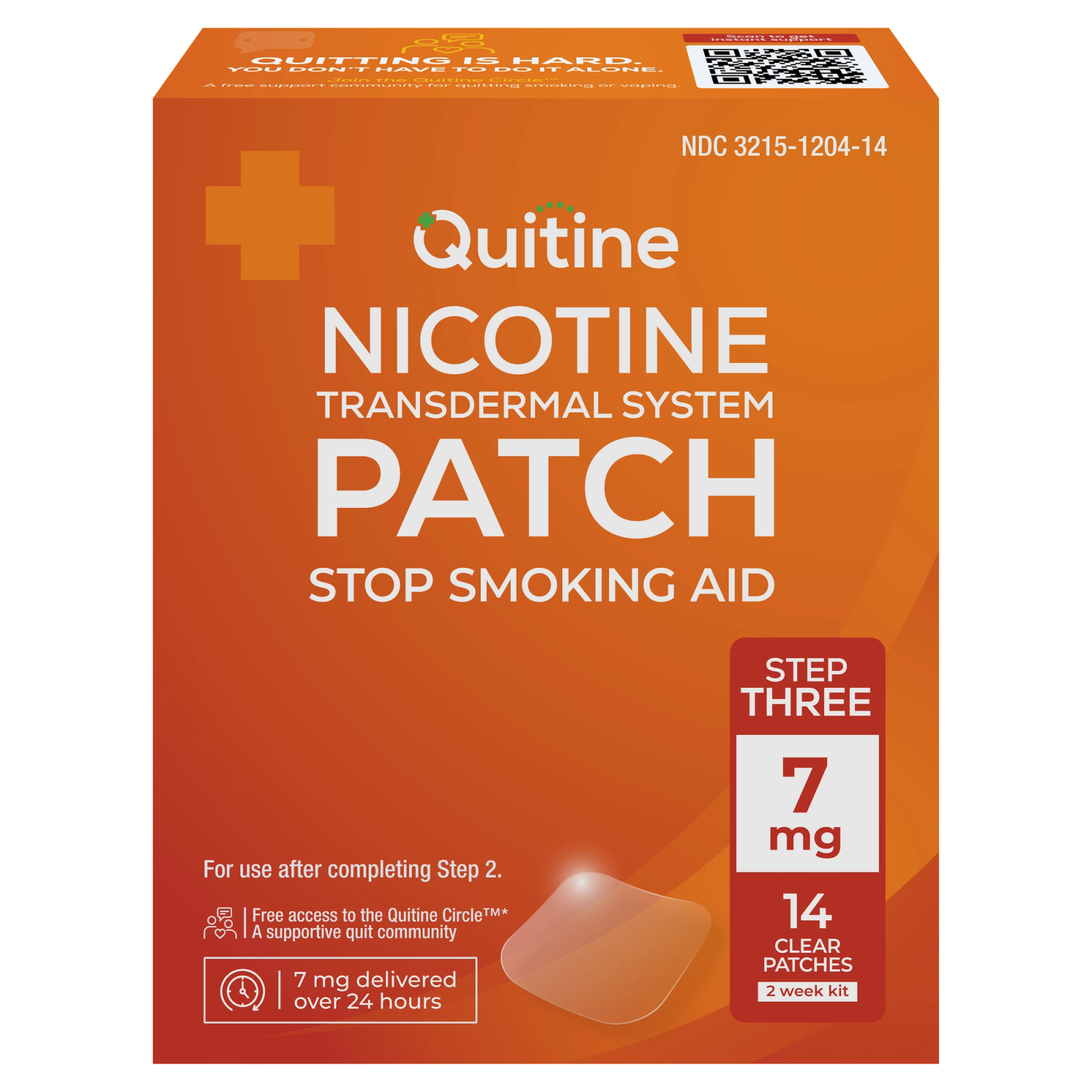
Description (Quitine Nicotine Patches Step 3 7mg 14 Pieces):
14 patches (2-week kit)
Use after you finish Step 2. This is the final taper. You can use the patches alone or add 2 mg gum or lozenges on harder days.
Quitine nicotine patches are an FDA-regulated stop-smoking aid. Each one delivers a steady amount of nicotine through the skin over 24 hours. You apply one patch every morning to clean, dry skin. The patch works in the background all day so you can focus on changing the habit itself.
How to use
- Choose a clean, dry, hairless area of skin on your upper arm, chest, or back. Skip any lotions or oils before you put the patch on.
- Peel the liner and press the patch firmly for 10 to 20 seconds. Smooth the edges so it stays in place.
- Wear the patch for a full 24 hours through everyday activities.
- After 24 hours, take it off and put a new patch on a different skin site. Rotate the location each day for comfort.
Stop use if skin irritation appears and follow the package directions.
FAQ
Do nicotine patches still matter if new quit drugs are in the pipeline?
Yes. Pipeline drugs and devices take years to clear safety, dose, and manufacturing hurdles. Licensed nicotine patches already have a known dose, a known step-down, and a long safety record in people who want to quit smoking or vaping. New work on antibodies, receptor modulators, and psychedelics may add options later. For now they sit beside the patch, not in place of it.
Why do researchers keep studying the patch format instead of only pills?
Skin delivery skips the gut and the first pass through the liver. The dose rises slowly and stays flatter. That profile is useful for withdrawal and for research that needs a stable nicotine level. It is also why materials labs keep testing nanofibers, microneedles, and gentler adhesives. A better film could mean fewer skin problems and more even blood levels, without changing the active ingredient.
Should I wait for personalized nicotine monitors before I quit?
No. Wearable nicotine monitors are still a research goal. You can personalize a quit smoking plan today with starting strength, combo nicotine gum or lozenges, site rotation, and a step-down that follows your cravings. Waiting for a future sensor only delays the health gain of stopping smoke and vapor.
How do I pick a starting patch if I also vape?
Treat time to first nicotine as the guide, not only cigarette count. If you reach for a vape soon after waking, many people start on the higher patch step and add an oral product for spikes. The same 21 mg, 14 mg, and 7 mg drop still applies.
Join the 90-Day Quit Challenge.
Read Also:

Ready to Quit or Just Cut Back?
If you're reading about nicotine, vaping, or smoking habits, chances are you're already thinking about making a change.
You don't have to figure it out alone. The Quitine Circle is our free support community, open to everyone quitting smoking or vaping. No purchase is required, and you do not need to use Quitine products to participate.
Inside the Quitine Circle you'll find:
The 90-Day Quit Program to guide your step down plan
A printable Quit Program Workbook to track progress
Practical tools for managing cravings and triggers
Support from others going through the same process
Quitting works best when you combine the right tools with the right structure. That's exactly what the Quitine system is built for.
Take our short quiz to see which Quitine Quit Kit fits your nicotine habits.

Not Sure Which Product Is Right for You?
Take our 2-minute Quit Quiz and get a personalized product recommendation and 90-day system based on your smoking or vaping habits.